The DOEL 2026 Automatic Smart Litter Box Review: Is It Worth It?
The DOEL 2026 Automatic Smart Litter Box Review
Affiliate disclosure
Affiliate disclosure: We may earn a commission if you purchase through links to this product, at no additional cost to you. This does not affect our assessment or the price you pay.
Is the DOEL 2026 automatic smart litter box worth considering?
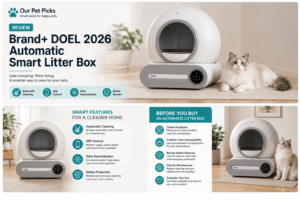
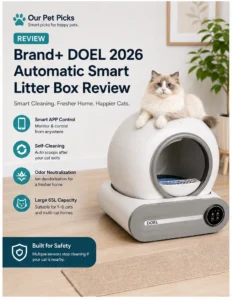
If you’re tired of scooping litter every day, the DOEL 2026 Automatic Smart Litter Box is designed to automate much of the routine cleaning process.
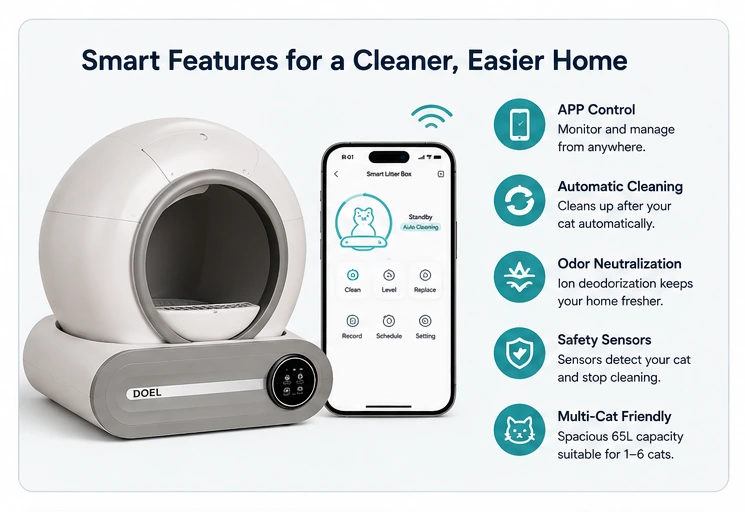
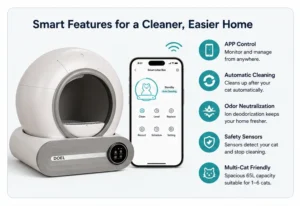
The listing supplied for this review presents it as a large-capacity automatic litter box with app control, 2.4 GHz Wi-Fi connectivity, automatic cleaning, odor-neutralization features, and safety sensors. The listing also positions it for multi-cat households.
That sounds appealing, especially for busy cat owners.
But there is an important distinction: “automatic” does not mean “maintenance-free.” Cats still need clean, appropriate litter facilities, and the machine itself still needs regular cleaning and monitoring. Veterinary guidance recommends keeping litter boxes clean, and households with multiple cats generally need more litter-box capacity rather than relying on automation alone.
So our assessment is straightforward:
The DOEL 2026 looks most interesting for cat owners who prioritize automation and smart features, but buyers should verify the exact specifications, safety system, compatibility, dimensions, warranty, and return terms before ordering.
Quick verdict
| Our assessment | |
|---|---|
| Review type | Research-based |
| Species | Cats |
| Best suited to | Owners interested in automated litter maintenance |
| Potential advantage | Automation and app-based monitoring |
| Potential limitation | Large smart appliances require space, setup and maintenance |
| Key consideration | Confirm exact model specifications and safety documentation |
| Multi-cat use | Listing positions it for multi-cat households |
| Price | Check current AliExpress listing |
| Recommendation | Worth investigating, but verify before purchasing |
[CHECK THE CURRENT ALIEXPRESS LISTING]
What is the DOEL 2026 Automatic Smart Litter Box?
The DOEL 2026 is an automatic self-cleaning cat litter box.
Rather than requiring the owner to manually scoop every waste clump, the machine is designed to automate the cleaning cycle.
The supplied listing highlights:
- Automatic cleaning
- App control
- 2.4 GHz Wi-Fi connectivity
- Odor-neutralization technology
- Safety sensors
- Large 65-liter capacity
- Compatibility with clumping litter
- A design intended for multi-cat households
The product page shown in your screenshot also presents the unit as a relatively substantial enclosed appliance rather than a simple open litter tray.
That matters because space is one of the first things a buyer should consider.
A large automatic litter box can reduce daily manual work, but it can also take considerably more floor space than a traditional litter pan.
Our review methodology
This is not a hands-on test.
We did not use the litter box with a cat, measure its noise level, test the cleaning cycle, test the app, or independently verify its safety sensors.
That distinction is important because your Our Pet Picks editorial rules specifically prohibit presenting a product as tested when it has not actually been tested.
Instead, this review evaluates:
- The product information visible in the supplied listing.
- Product-category considerations.
- Current veterinary and pet-care guidance.
- Practical suitability for different cat households.
- Limitations that a buyer should consider before ordering.
Where information could not be independently verified, I’ve left it out rather than guessing.
Key features of the DOEL 2026 automatic smart litter box
Automatic cleaning
The central selling point is automation.
Instead of manually scooping after each use, an automatic litter box is designed to separate waste from usable litter through a mechanical cleaning process.
For a busy household, that can potentially reduce the amount of routine litter box work.
However, the machine should not be treated as a replacement for litter box hygiene.
Veterinary guidance still recommends regular litter-box cleaning, and automatic boxes require maintenance of their own. PetMD’s veterinary-reviewed guidance specifically notes that self-cleaning litter boxes still need periodic manual cleaning.
Our assessment
Potential advantage: Less repetitive scooping.
Important limitation: It does not eliminate cleaning and maintenance.
App control and smart monitoring
The listing highlights app control and 2.4 GHz Wi-Fi connectivity.
For owners who like smart-home devices, this could be useful because it potentially allows the litter box to be monitored or controlled through a smartphone.
The practical value depends heavily on the quality of the app, connection reliability, notifications, and setup process.
Those aspects have not been independently tested by Our Pet Picks.
Therefore, we would treat the app as a potentially useful convenience feature rather than a reason by itself to buy the product.
Before ordering, check:
- Which app is required?
- Is the app available in your region?
- Is 2.4 GHz Wi-Fi required?
- Does the app require an account?
- Are there subscription fees?
- What information does the app collect?
- Does the machine continue operating if Wi-Fi disconnects?
These details should be confirmed from the current listing or documentation.
Odor control
The listing promotes odor-neutralization technology.
Odor control is a meaningful consideration because waste sitting in a litter box can create unpleasant smells, particularly in small homes or multi-cat households.
But we would not describe the DOEL as eliminating odors or guaranteeing an odor-free home.
Those outcomes depend on factors such as the following:
- litter type,
- cleaning frequency,
- number of cats,
- ventilation,
- waste-bin maintenance,
- and individual cat habits.
The manufacturer/listing claim should therefore be treated as a product feature claim rather than independently proven performance.
Safety sensors: an important feature to investigate
Automatic litter boxes contain moving mechanisms, so safety deserves more attention than simply asking whether the machine is convenient.
The supplied listing highlights safety protection/sensors.
That’s encouraging, but we have not independently verified the exact sensor configuration or how the system behaves under different conditions.
This is one of the most important areas to verify before purchasing.
Ask:
- What sensors are included?
- Does the cleaning cycle stop when a cat enters?
- Is there an automatic delay after use?
- What happens if an obstruction is detected?
- What happens after a power interruption?
- What happens if a sensor becomes dirty?
- Is there a manual emergency stop?
Do not assume that a product is completely safe simply because the listing uses terms such as “safety protection.”
Is it suitable for multiple cats?
The listing positions the 65-liter model for multi-cat households.
A larger litter-box design can certainly be attractive when several cats share the home.
However, one large automatic litter box should not automatically be considered a replacement for providing multiple litter boxes.
The CDC recommends one litter box per cat plus one additional box as a general household guideline, while Cornell’s feline behavior guidance similarly recommends maintaining multiple boxes based on the number of cats.
So a household with several cats should consider the DOEL as one part of the litter-box setup, rather than assuming one machine will meet every cat’s needs.
Litter compatibility
The supplied listing indicates compatibility with clumping litter.
That’s important because automatic cleaning mechanisms generally depend on the litter forming usable clumps.
Before buying, verify the exact approved litter type in the current product documentation.
Do not assume that every clumping litter will perform identically.
Also consider your cat.
Cornell notes that cats often have preferences regarding litter texture and other litter-box characteristics.
If your cat strongly prefers a particular litter, compatibility should be checked before replacing the existing setup.
Space and placement
This is one of the biggest practical considerations.
The DOEL is substantially larger than a basic litter tray, so owners should measure the intended location before ordering.
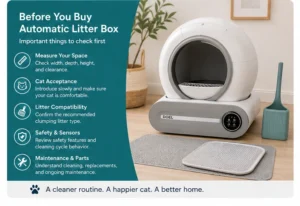
Look at:
- Available floor width
- Depth
- Height clearance
- Doorway access
- Electrical outlet location
- Wi-Fi signal
- Room for opening/servicing the machine
- Space around the entrance
The box should also be placed somewhere your cat can comfortably access.
Cornell recommends a litter box location that is quiet, private, accessible, and appropriate for the individual cat.
Pros and cons
Pros
- Automatic cleaning: Potentially reduces repetitive scooping.
- Smart connectivity: App functionality may appeal to tech-oriented owners.
- Large-capacity design: The listing positions the unit for multi-cat households.
- Odor-control feature: Useful for owners particularly concerned about litter box smells.
- Safety-focused design: The listing identifies sensor-based protection as a feature.
Cons
- Large footprint: It may not suit a small apartment or compact bathroom.
- More complicated than a traditional litter box: Smart appliances introduce additional setup and maintenance.
- Exact safety performance needs verification: The listing’s safety claims have not been independently tested by Our Pet Picks.
- Litter compatibility matters: Buyers should confirm the exact litter requirements.
- Ongoing maintenance remains necessary: Automatic cleaning does not mean zero cleaning.
Who should consider the DOEL 2026?
This product may be worth considering if you:
Have multiple cats
The large-capacity design is one of the most relevant features for a multi-cat household.
Want less routine scooping
If your main frustration is repeatedly cleaning waste from a conventional litter box, automation could be attractive.
Like smart-home technology
The app and Wi-Fi features may appeal to owners who enjoy monitoring household devices from their phones.
Have enough floor space
A large automatic litter box needs an appropriate location with sufficient clearance.
Who should skip it?
A different solution may make more sense if
- You have very limited floor space.
- Your cat is uncomfortable with enclosed litter box designs.
- Your cat is highly sensitive to changes in litter-box setup.
- You prefer simple products with fewer electronic components.
- You don’t want to maintain an app-connected appliance.
- You cannot verify the exact safety and warranty information you need.
- Your cat has a health problem that requires close observation of litter-box behavior.
That last point deserves special attention.
A litter box can provide useful information about a cat’s normal bathroom habits. Changes in litter-box use, urine, stool, or frequency can sometimes be important health signals.
Automation should therefore make routine care easier—not make owners less observant.
Automatic litter boxes and cat health
One potential downside of automation is that owners may interact less directly with the litter box.
That’s worth remembering because litter-box habits can provide useful clues about a cat’s health.
If you notice a significant change in your cat’s bathroom behavior, don’t assume that the machine is simply malfunctioning.
For concerning changes, particularly changes accompanied by other symptoms, contact your veterinarian.
The DOEL should be viewed as a convenience product, not a diagnostic device or treatment.
How to introduce a cat to an automatic litter box
Don’t assume your cat will immediately accept a new machine.
Cats can be particular about their litter-box environment.
A sensible transition is
- Keep the familiar litter type initially.
- Place the new box in an appropriate, accessible location.
- Allow your cat time to investigate it.
- Avoid forcing the cat inside.
- Monitor whether your cat actually uses it.
- Keep an alternative litter box available during the transition.
- Follow the manufacturer’s setup instructions before activating automatic cleaning.
If your cat begins avoiding the litter box, don’t keep forcing the change. Litter-box avoidance can have behavioral or medical causes and deserves attention. Cornell recommends considering the cat’s environment, litter preferences, and health when house-soiling problems occur.
DOEL vs. a traditional litter box
| Option | Best for | Main advantage | Main limitation |
|---|---|---|---|
| Brand+ DOEL automatic litter box | Owners wanting automation | Less routine scooping | More complex and requires space |
| Traditional open litter box | Owners wanting simplicity | Low cost and easy maintenance | Requires manual scooping |
| Large open litter box | Large cats or cats needing more room | Spacious and simple | Still requires frequent manual cleaning |
| Another premium automatic model | Owners prioritizing established smart features | More advanced feature sets may be available | Usually higher purchase cost |
The right choice depends more on your cat and household than on the number of features.
A simple litter box can be the better choice if your cat dislikes enclosed designs or if you want something inexpensive and easy to replace.
An automatic model becomes more attractive when reducing repetitive cleaning is a high priority.
Value for money
We would not publish the $155.15 price shown in your screenshot as the article’s permanent price.
Your own affiliate-compliance material correctly warns against leaving outdated pricing and availability claims in published content.
The screenshot shows a promotional/new-shopper price, which can change based on account status, promotion, location, and time.
So the article should say:
Check the current AliExpress listing for today’s price, available variations, shipping information, and applicable promotions.
Check the current AliExpress listing
When judging value, compare the total purchase cost with:
- the size of the machine,
- included components,
- expected maintenance,
- replacement parts,
- litter requirements,
- warranty,
- return policy,
- and the availability of customer support.
Final verdict
The Brand+ DOEL 2026 Automatic Smart Litter Box is an interesting option for cat owners who want to move away from completely manual litter box cleaning.
Its strongest appeal is the combination of automatic cleaning, smart connectivity, odor-control features, and a large-capacity design.
But this is not a product we’d recommend simply because it has more technology.
The most important questions are whether your cat will comfortably use it, whether you have enough space, whether the required litter is suitable, and whether the exact safety, warranty, maintenance, and app details meet your expectations.
Our conclusion: the Brand+ DOEL 2026 appears worth considering for busy cat owners and multi-cat households that want more automation, but it should be purchased only after verifying the exact current specifications and safety documentation.
[CHECK CURRENT PRICE & OPTIONS ON ALIEXPRESS]
FAQs
Is the Brand+ DOEL 2026 suitable for multiple cats?
The supplied listing positions the model as suitable for multi-cat households. However, households with multiple cats should still consider providing multiple litter boxes rather than relying on one automatic unit.
Does the Brand+ DOEL litter box clean itself?
The product listing presents it as an automatic self-cleaning litter box. However, “self-cleaning” does not mean maintenance-free. The machine and surrounding area still require regular cleaning.
Does it require Wi-Fi?
The supplied listing specifies 2.4 GHz Wi-Fi connectivity. Verify the current listing and documentation before purchasing, especially if your home network uses separate 2.4 GHz and 5 GHz networks.
Can I use any cat litter?
The supplied listing indicates compatibility with clumping litter. Confirm the manufacturer’s current litter requirements before ordering.
Is an automatic litter box better than a traditional litter box?
Not automatically. An automatic model can reduce routine scooping, while a traditional box is simpler and usually easier to maintain. The best choice depends on your cat’s preferences, your space, your budget, and your willingness to maintain the equipment.
Should I stop monitoring my cat’s litter habits because the box is automatic?
No. Changes in litter-box use or waste can sometimes provide useful health information. Automatic cleaning should not replace normal observation of your cat
Sources
- AliExpress product listing
- AliExpress Affiliate Program Agreement
- Merck Veterinary Manual — Providing a Litter Box for a Cat
- Cornell Feline Health Center — House Soiling
- CDC — Healthy Pets, Healthy People: Cats
- PetMD — Automatic Litter Boxes