
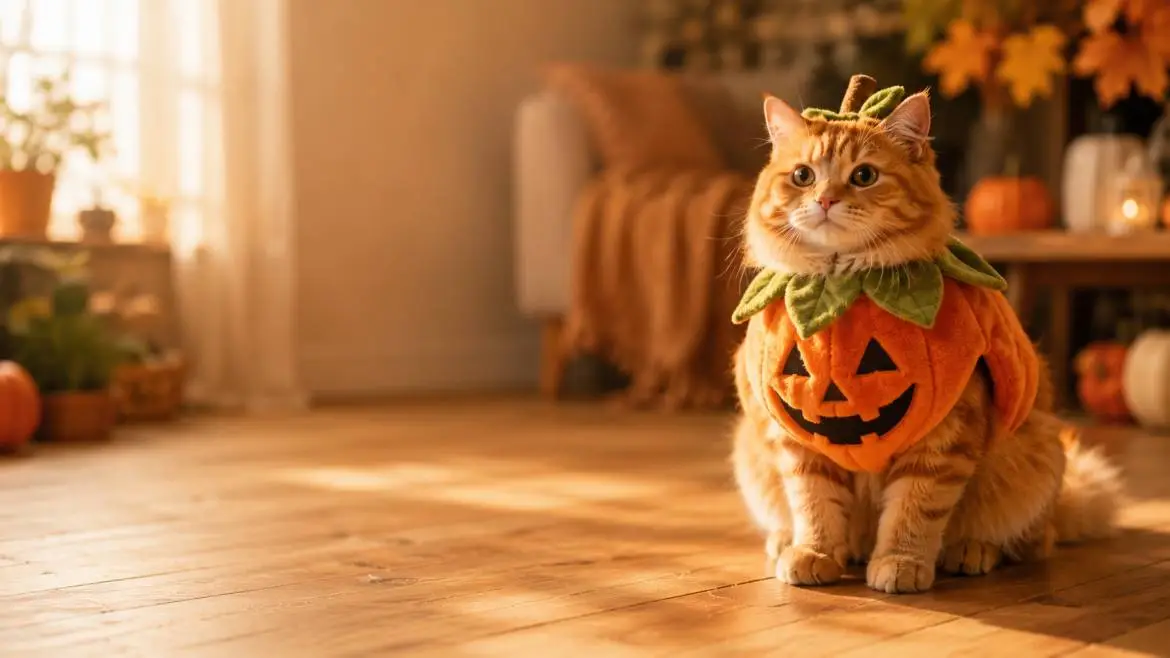
Halloween Costumes for Cats: A First-Time Owner’s Honest Guide
Halloween Costumes for Cats: A First-Time Owner’s Honest Guide
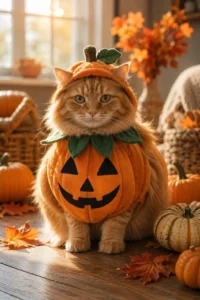
What to know before you buy that tiny pumpkin outfit — and how to keep the whole thing fun instead of stressful.
You’re standing in the pet store aisle, phone out, scrolling through hot dog costumes and tiny witch hats, wondering if your cat would actually tolerate any of these Halloween costumes for cats. Maybe you just adopted your first cat this year. Maybe you’ve seen one too many “cat in a shark costume riding a Roomba” videos and you want in on the fun. Either way, you’ve landed in the right place: this is your honest, practical guide to Halloween costumes for cats—what actually works, what to skip, and how to tell if your cat is even up for it.
Key takeaways
- Most cats tolerate costumes briefly rather than enjoy them—and that’s genuinely fine.
- The best predictor of costume tolerance is whether your cat already sits calmly for a harness or collar.
- Simple accessories (collars, bandanas, capes) are safer and easier than full-body costumes.
- Avoid anything with dangling bits, bows, or ribbons — cats chew and swallow them, which can mean emergency surgery.
- If your cat is newly adopted and still in the “3-3-3” adjustment window, skip the costume this year.
Let’s start with the question nobody wants to hear the real answer to
Do cats actually like wearing costumes? Mostly, no. Veterinary behaviorists are pretty consistent on this: cats are not dogs, and they didn’t evolve to enjoy having fabric draped over their bodies. Some cats genuinely couldn’t care less and will strut around like nothing happened. Others will freeze, flop over dramatically, or spend the next twenty minutes trying to bite the costume off. Both reactions are completely normal.
Here’s the thing, though—”doesn’t love it” and “can’t handle it at all” are two very different things. A lot of cats fall somewhere in the middle: they’ll tolerate a costume for a few minutes, especially with treats involved, which is honestly all you need for a cute photo and a fun holiday memory.
The single best test: the harness rule
If you’ve never dressed your cat in anything before, there’s a genuinely useful shortcut for guessing how this will go: think about how your cat handles a harness or collar. If your cat is already comfortable wearing a collar and doesn’t fight you when you clip on a harness for vet visits, there’s a decent chance they’ll tolerate a similarly lightweight costume too. If your cat has never worn so much as a collar and hates being handled around the neck or back, a full costume is probably going to be a bigger ask than it’s worth.
This matters even more if you’re a brand-new cat owner. If you just brought your cat home in the past few months, you’re likely still in what’s often called the 3-3-3 adjustment period—the first three days of hiding and overwhelm, the first three weeks of settling in, and the first three months before your cat’s real personality and comfort level fully show up. A cat who’s still finding their footing in a new home is not the ideal candidate for their first costume experiment. There’s always next Halloween.
Skip the full-body suit—start smaller
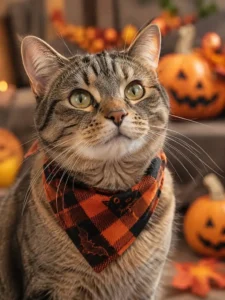
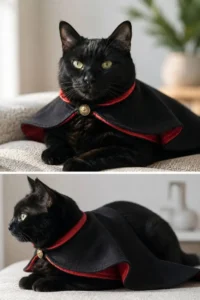
One thing that surprised me looking into this: the costumes cats tend to tolerate best aren’t the elaborate ones. They’re the simple ones. A soft collar, a bandana, or a cape that drapes over the back and clips at the neck (the same basic idea as a harness) tends to go over far better than a full-body suit with sleeves, a hood, and elastic loops around all four legs.
If you want to go bigger — say, a hot dog costume or a little witch outfit — that’s absolutely doable for cats who are already used to being handled and dressed. Just treat it as a “wear it for five minutes, get the photo, take it off” situation rather than something your cat wears all evening.
What to actually avoid buying
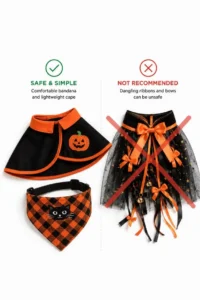
This is the part that matters more than the cute factor. The ASPCA’s Halloween safety guidelines line up with what most vets recommend, and a few real issues stand out when you’re shopping:
- Dangling decorations, bows, and ribbons. Cats love to chew on exactly this kind of thing, and if they swallow it, it can cause a blockage that requires emergency surgery. This is the single most avoidable Halloween costume risk.
- Anything that restricts breathing, movement, or vision. If a costume covers the eyes, pinches around the neck, or stops your cat from walking normally, it’s a hard no—even if your cat seems calm at first.
- Heavy or non-breathable fabric. Costumes are often made from cheap synthetic material that traps heat. Keep it short and watch for panting or restlessness.
- Anything ill-fitting. Measure your cat before buying online. Too tight is uncomfortable; too loose means paws get tangled and costumes get chewed off (see point one).
These are the cat-specific risks, but Halloween brings extra hazards for pets overall — from candy and chocolate to noise stress and open doors. If you have a dog too, or just want the fuller picture, our Halloween The Pet Safety: 10 Tips for Dogs & Cats guide covers it all.
How to actually introduce the costume
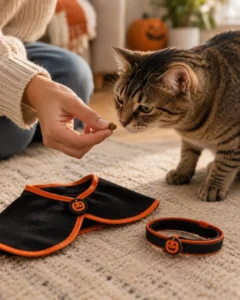
Don’t just wrestle your cat into a costume five minutes before trick-or-treaters show up. A slower approach works far better:
- Let it sit out first. Leave the costume somewhere your cat hangs out for a few days so they can sniff and investigate it on their own terms.
- Do a short trial run. Put it on for thirty seconds, give treats, and take it off. Repeat over a few days rather than going straight for the full outfit on Halloween night.
- Watch the body language. Hissing, flattened ears, frantic scratching at the fabric, hiding, or trying to bolt are all signs to stop, not signs to push through.
- Keep sessions short. Even for cats who tolerate it well, a few minutes for photos is plenty. This isn’t meant to be an all-evening costume.
And if, after all that, your cat clearly hates it? That’s a completely valid outcome. A festive collar or bandana still counts as “dressed up for Halloween,” and your cat will thank you for reading the room.
Where to actually find one
You don’t need to hunt far. Petco and Chewy both carry seasonal cat-specific Halloween costume lines every year, ranging from simple collars up to full character costumes, and big-box retailers like PetSmart, Walmart, and Tractor Supply typically stock a smaller seasonal selection in the pet aisle come October. If you’re crafty, a no-sew bandana or a soft cape made from an old t-shirt and a bit of Velcro is genuinely one of the easiest DIY pet projects out there, and it sidesteps most of the safety concerns above since you control exactly what goes on it.
Our comfort picks, if you’d rather just buy one
This post contains affiliate links. We may earn a small commission if you purchase through them, at no extra cost to you.
If you’d rather skip the DIY route, here are eight options we like specifically because they’re lightweight, adjustable, and easy to remove the moment your cat’s had enough — arranged from lowest-commitment to full costume:
1. CZolden Pumpkin Hat
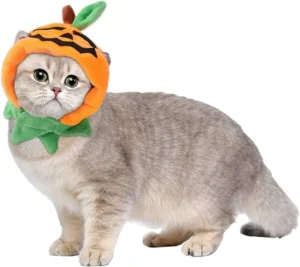
Just a soft plush hat—no body piece at all. The lowest-commitment option here, and a good first test for a cat who’s never worn anything. View on Amazon
2. Ghost Hat & Spider Bandana Set
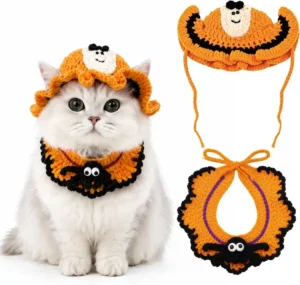
The bandana here is the real star—a soft, breathable spider-print bandana you can use on its own, with a lightweight ghost hat you can leave off entirely if your cat’s not a hat cat. Handmade knitted fabric, adjustable fit, no restriction on movement. View on Amazon
3. LOKIPA Bat Wings, Witch Hat & Bell Collar Value Pack
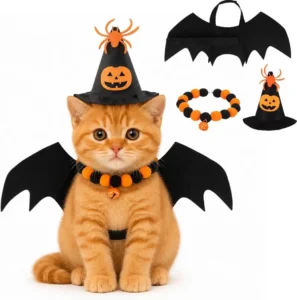
Our top pick for first-timers who want more than one option in the box. Start with just the bell collar, and “graduate” to the witch hat or bat wings only if your cat tolerates it well. Soft felt construction with adjustable straps so nothing feels tight. View on Amazon
4. CZolden / Bolbove-style Pumpkin Hat with Ear Holes
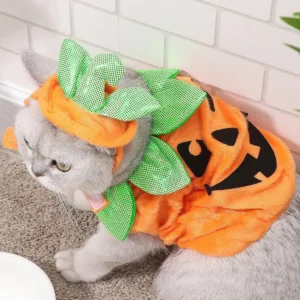
Soft plush, adjustable strap, designed with ear holes so it doesn’t muffle hearing or flatten ears the way a full hood can. View on Amazon
5. Puoyis Cat Bat Wings
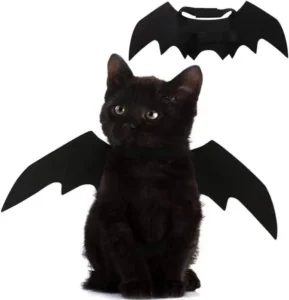
Lightweight felt wings with Velcro fastening at the neck and chest — no leg loops or hood to fight with. Consistently a best-seller in the cat apparel category. View on Amazon
6. OMG Adorables Lion Mane
A breathable cotton-poly blend pullover hood with plush ears — no body restriction at all, just a mane around the head and neck. View on Amazon
7. Pet Krewe Lion Mane
From a well-established pet costume brand, this one’s easy hand-wash care and a similar low-restriction mane design, just a step up in build quality. View on Amazon
8. ADOGGYGO Pumpkin Cloak & Hat Set
A cape-style cloak rather than a full-body suit, made from lightweight flannel — the closest thing on this list to a full costume that still follows the “cape over full suit” rule. View on Amazon
Whichever one you pick, do the slow introduction from the section above before Halloween night itself — and always double-check the current listing for size, price, and stock before buying, since these can change.
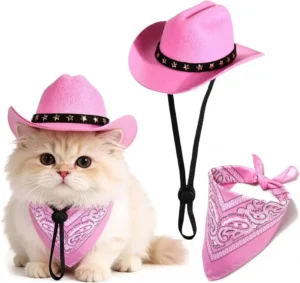
9.Pet Cowboy Costume, Cowboy Hat with Bandana Scarf
The bottom line
Dressing up your cat for Halloween isn’t cruel, and it isn’t mandatory — it’s just something worth doing thoughtfully. Pick something simple, test the waters before the big night, skip anything with parts your cat could chew and swallow, and let your cat’s actual reaction (not the adorable product photo) be the deciding factor. If they tolerate it, you get a great photo. If they don’t, you get a very honest reminder of who’s really in charge of this household.
Frequently asked questions
Do cats actually like wearing Halloween costumes?
Mostly not, but that’s okay. Most cats will tolerate a costume for a short stretch rather than genuinely enjoy it, while a small number don’t mind it at all. Very few cats will actively love the experience—treat “tolerates it for a few minutes” as a win.
Can I put my cat in a costume, or is it cruel?
It’s not inherently cruel as long as you’re paying attention to your cat’s comfort. Keep sessions short, choose lightweight materials, and stop the moment your cat shows signs of stress. Forcing a stressed cat to keep wearing something is where it crosses the line — reading their body language is what makes the difference.
What is the best Halloween costume for a cat?
Simple beats elaborate. A soft collar, bandana, or a cape-style piece that clips at the neck (similar to a harness) is far better tolerated than a full-body suit with a hood and leg loops. If your cat already handles a harness well, you can go bigger — think pumpkin vests or lightweight character costumes.
How do I get my cat to wear a costume without stressing them out?
Introduce it gradually: let the costume sit out for your cat to sniff for a few days, do short trial fittings with treats, and build up slowly instead of putting the full costume on for the first time on Halloween night itself. Watch for hissing, flattened ears, or attempts to bolt as your cue to stop.
What is the 3-3-3 rule for cats, and why does it matter for costumes?
It’s a guideline for how newly adopted cats settle in: roughly three days of overwhelm, three weeks of learning the routine, and three months before they’re fully comfortable and showing their real personality. If your cat is still within that window, it’s best to skip the costume this year and let them settle in first.
What costume features should I avoid for safety reasons?
Skip anything with dangling ribbons, bows, or small decorations—cats chew on them, and swallowing pieces can cause a serious intestinal blockage. Also avoid costumes that restrict breathing, vision, or movement, and steer clear of heavy, non-breathable fabric that can overheat your cat. For the full rundown of Halloween hazards beyond costumes, see our [Halloween Pet Safety guide].”
Where can I buy a cat Halloween costume?
Petco and Chewy both run seasonal cat-specific costume lines each year, and PetSmart, Walmart, and Tractor Supply typically carry a smaller selection in their pet aisles around October. A simple DIY bandana or cape made from an old t-shirt is also an easy, low-risk option if you’d rather skip buying one.
Already tried a costume on your cat this year? I’d genuinely love to hear how it went—the triumphant five-minute photoshoots and the costumes-shredded-in-ten-seconds stories are all worth sharing. Drop a comment below with what worked (or spectacularly didn’t) for your cat.




One Comment
Comments are closed.