The Complete Dachshund Supply Guide: Beds, Harnesses and Ramps for Long-Backed Dogs
The Complete Dachshund Supply Guide: Beds, Harnesses, and Ramps for Long-Backed Dogs
Affiliate disclosure: This guide may contain affiliate links. If you buy through them, we may earn a small commission at no extra cost to you. It never changes what we recommend.
Health note: This article is general education, not a diagnosis. If your dachshund yelps, hunches, wobbles, or drags a back leg, call your vet right away. Health facts below come from veterinary institutions and peer-reviewed studies; practical buying tips (ramp length, harness, and bed fit) are editorial guidance, not veterinary research. The one exception is car-crash testing, which comes from an independent safety nonprofit because veterinary bodies don’t test restraints.
Picture a Saturday morning. Your dachshund is on the sofa, watching you with that look that says the floor is beneath me. Then, without warning, he launches himself off the cushion. Four little legs, one very long back, and a hard landing on tile.
Nothing happens. He trots off, tail up. You exhale.
Here’s the uncomfortable truth: a dachshund’s discs are fragile mostly because of genetics, and a hard landing can be what tips an already-weakened disc over the edge. You can’t change the genes. You can cut down on falls and everyday strain, and a few well-chosen supplies, a bed, a harness, and a ramp, help with that. None of them is a guarantee, so this guide is upfront about where the evidence is solid and where it’s thin.
This guide is the one I wish every new dachshund owner got on day one. No fluff, no gadget-hoarding. Just what’s worth buying from a long time ago, and how to choose it without wasting money.
Key takeaways
- Estimates of lifetime disc disease (IVDD) risk in dachshunds range from roughly 16 to 25 percent, and the breed’s risk is 10 to 12 times that of other dogs, so it’s worth planning for.
- A ramp should be long and shallow, grippy, and wobble-free. Steep, short ramps are the most common mistake.
- A well-fitted harness keeps leash pressure off the neck. It’s good practice, but no study shows it prevents disc disease, and fit matters more than shape.
- A supportive, low-entry bed beats a plush, deep one. Your dog should step in, not hop in.
- Keep your dachshund lean and active. Cornell recommends it, though research on weight and IVDD risk is mixed.
- In the car, use a restraint that an independent group has actually crash-tested.
- If your dog has already hurt his back, follow your vet’s plan. Specialists recommend at least four weeks of restricted activity, with no jumping or stairs.
Why your dachshund’s back needs special gear in the first place
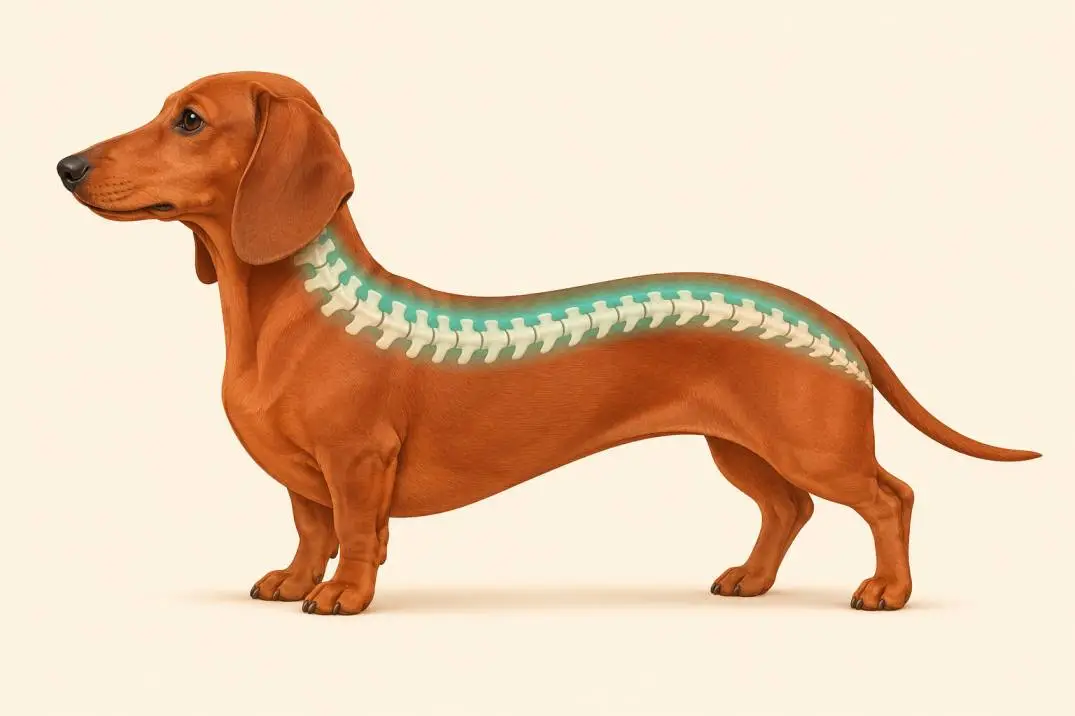
That famous silhouette isn’t just cute. It comes from a short-legged body type called chondrodystrophy, and it carries a cost. A Royal Veterinary College survey of more than 2,000 dachshunds (Packer et al., 2016) found that about 16 percent had been diagnosed with IVDD, with big differences by variety: roughly 24 percent of standard smooth-haired dachshunds against 7 percent of standard wire-haired. The RVC authors also cite a relative risk 10 to 12 times that of other breeds, and older estimates of lifetime risk run higher. Science for Animal Welfare (formerly UFAW) cites about 25 percent, says disc degeneration can begin as early as four months of age, and reports that about 80 percent of dachshund cases appear between ages three and seven.
The Cornell Richard P. Riney Canine Health Center reports that the American College of Veterinary Surgeons estimates dachshunds account for 40 to 75 percent of all IVDD cases. Its prevention advice is plain: keep the dog trimmed and fit, and minimize stairs and jumping on and off beds, sofas, and decks. Cornell’s chondrodystrophy and IVDD guidance also suggests steps or ramps to reduce jumping.
Now, some honesty, because I don’t like posts that oversell. Genetics is the biggest driver, and no ramp or harness rewrites that. The evidence on lifestyle is also messier than you’d expect. In the RVC survey, dogs that were not allowed to jump on and off furniture actually had higher odds of IVDD, and dogs exercised for more than an hour a day had lower odds. The authors warn this may be reverse causation (owners often restrict a dog after a bad episode) and say they can’t make firm recommendations from it. An older Danish study of 48 wirehaired dachshunds (Jensen and Ersbøll, 2000) found moderate stair climbing associated with less disc calcification. So you can’t bubble-wrap a dachshund, and you shouldn’t try. Science for Animal Welfare does note that a jump or fall can set off a herniation in an already-degenerated disc. What gear can realistically do is cut falls and hard landings and keep a dog who’s had a back problem safer while you keep daily activity up.
Ramps: the one purchase I’d make first
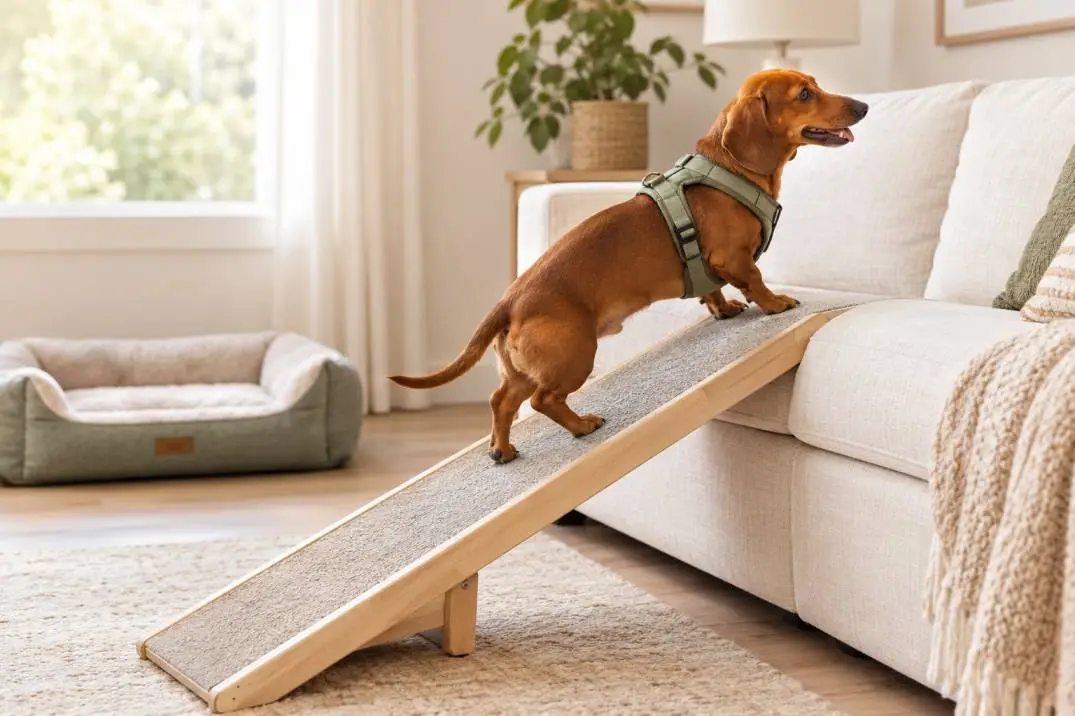
If you buy only one thing from this guide, make it a ramp for whatever your dog climbs most: the sofa, the bed, or the car.
What actually makes a good Dachshund ramp?
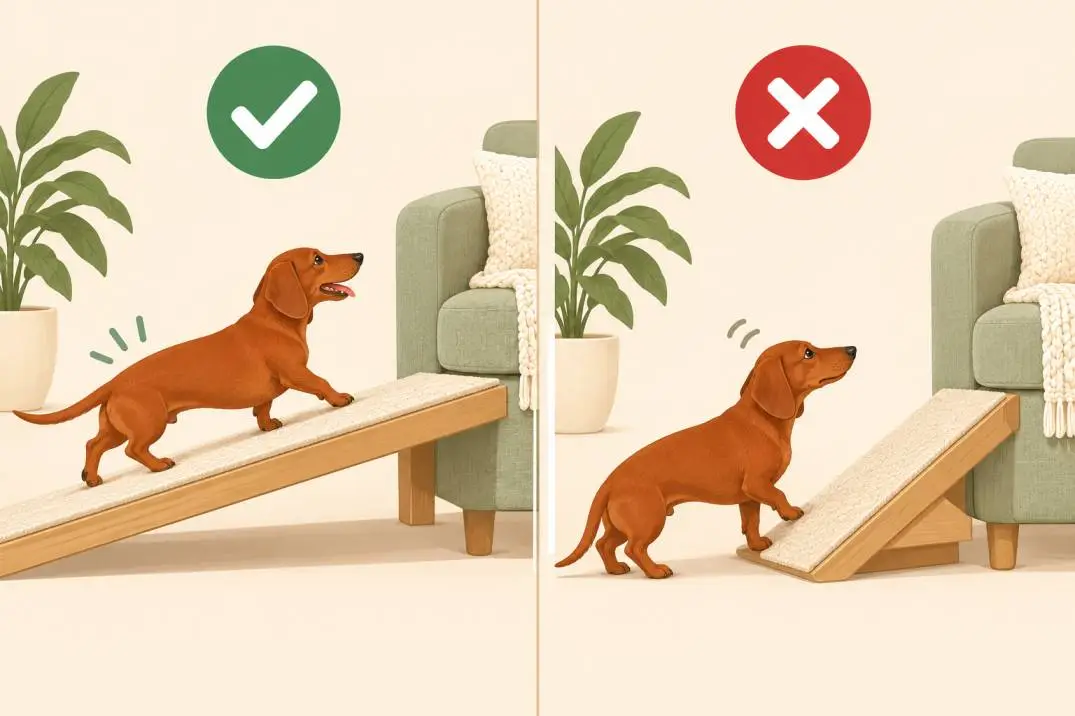
A gentle slope. This is the big one. You want something closer to a wheelchair ramp than a ladder. As a rough rule of thumb (mine, not a published standard), choose a ramp about two and a half to three times as long as the height it has to cover. A sofa seat that sits 18 inches off the floor wants a ramp of roughly four feet or more. If the ramp is short and steep, your dog may skip it entirely and jump anyway.
Real traction. Look for a textured or carpeted surface that grips little paws, especially on the way down, when momentum does the talking.
Stability. Press down on the middle. If it flexes, bounces, or slides on your floor, walk away. A ramp that moves under your dog once will teach him never to trust it again.
Side rails or a lip. Dachshunds are not graceful. Low edges keep a wobbly step from becoming a fall.
Width and weight limit. A standard dachshund (16 to 32 pounds, per Purina’s breed profile) needs a sturdier, wider ramp than a miniature (up to about 11 pounds), but don’t buy so wide and heavy that you won’t want to move it.
Ramp or pet stairs?
For most dachshunds I lean toward a ramp. Stairs are fine if the steps are low and shallow and the dog already uses them calmly, but each step is still a small jump. Cornell’s chondrodystrophy guidance lists steps or ramps as ways to reduce jumping, so either is reasonable. Pet stairs make the most sense for a dog that dislikes ramps.
Teaching the habit
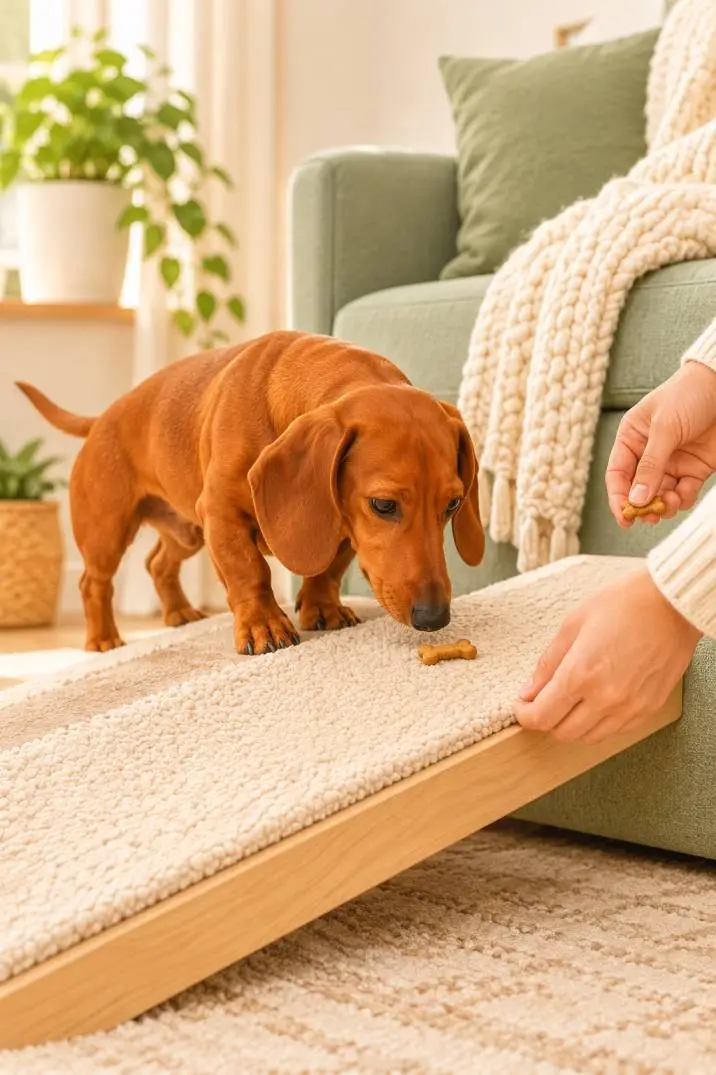
Most dachshunds won’t use a ramp because you bought one. Lay a few treats up the ramp, stay beside it, and reward every paw. Ten short, happy sessions beat one frustrating one. If your dog still launches off the couch, block the jump with a cushion or gate until the ramp becomes the easier option.
Ramps worth a look
Judge any ramp by the checklist above: long, shallow, grippy, and stable. These are the ones I’d start with.
- PetSafe CozyUp Bed Ramp: The manufacturer lists it as 70 inches long and 25 inches high, a length-to-height ratio of about 2.8, with a carpet surface. It’s a good fit for a bed. Push it flush against the bed, because some buyers report a wobble or a dog slipping into the gap.
- Easyego 74-inch Foldable Dog Ramp: a long wooden ramp with side rails and a carpet surface, listed with a 22-degree gentle slope. Check the slope at the height you need.
- ZENTAVO 73-inch Wooden Dog Ramp: listed with a 20-degree slope, a top platform, and a removable side rail.
- KUVETO Dog Ramp for Bed or Couch: listed with a 20-degree slope, removable side rails, and a non-slip surface.
Two traps to avoid when shopping. First, adjustable ramps get steeper on their taller settings, so check the angle at the height you actually need. Second, many Amazon results labeled “dog ramp” are really foam stairs, which are a different product.
Harnesses: kinder to the neck and easier to control
Picture a dachshund spotting a squirrel at the end of a leash attached to a collar. All that forward force goes through the throat and neck. Most dachshund disc disease sits in the back rather than the neck (about 88 percent thoracolumbar and 8 percent cervical among the cases in the RVC survey), but neck problems do happen, and a lunge on a collar is hard on any dog.
A harness moves that pull to the chest and shoulders. To be straight with you: no trial shows that a harness prevents IVDD, and the RVC survey found no significant link between walking on a harness or a collar and disc disease. The usual case for a harness is mechanical. It keeps leash pressure off the neck and gives you better control. That makes it a low-cost, low-risk choice and good practice, but not a spine shield.
What to look for
- Free shoulders. Pick a design whose straps sit in front of and below the shoulder blades, and check for visible space at the armpit when his front leg swings back. Research doesn’t agree on which shape is best. A small study of 30 pet dogs (“The Influence of Harness Design on Forelimb Biomechanics in Pet Dogs”) found a straight-front harness allowed the most shoulder and elbow movement and a front-clip design the least. It also notes that earlier studies reached mixed conclusions about Y-shaped designs and that poor fit changes gait. So judge by how your dog walks and trots in it, not by the label.
- Adjustable at neck and chest. Dachshunds have deep chests and slim waists, and off-the-shelf sizing is often wrong for them. Measure the widest part of the chest and compare with the size chart, not the dog’s weight.
- A snug, two-finger fit. You should slide two fingers under any strap, but the harness shouldn’t rotate or slip back.
- Nothing tight around the midsection. Avoid designs that clamp across the long, vulnerable back.
- Lightweight, breathable mesh for smooth coats; extra padding for sensitive skin.
- A top handle is a bonus for quick, controlled assists, but never lift a dachshund by a harness handle alone with the back hanging.
A quick note on handling, since it matters as much as gear: the standard advice is to support both ends, one hand under the chest and the other cradling the hindquarters, so the spine stays level. Ask your vet to show you the technique in person.
Harnesses worth a look
Measure your dog’s chest first, then compare with each size chart.
- Ruffwear Front Range Harness: a padded Y-shaped chest piece that adjusts at four points, with sizes reviewers list from about 13 to 42 inches of chest. It’s the most-recommended pick in the reviews I read, though one reviewer warns that sizing can be tricky on deep-chested breeds. It has both a back ring and a front loop. Because the harness study I mentioned found front-clip designs restricted shoulder movement the most, I’d use the back ring for everyday walks.
- Kurgo Tru-Fit Smart Harness: a budget-friendly padded option that reviewers list from about 12 inches of chest.
- Puppia Soft Dog Harness: a soft mesh harness for tiny dogs, with sizes that reviewers list from about 9 inches of chest. It’s worth a look for puppies and miniatures.
Beds: supportive, low and easy to step into
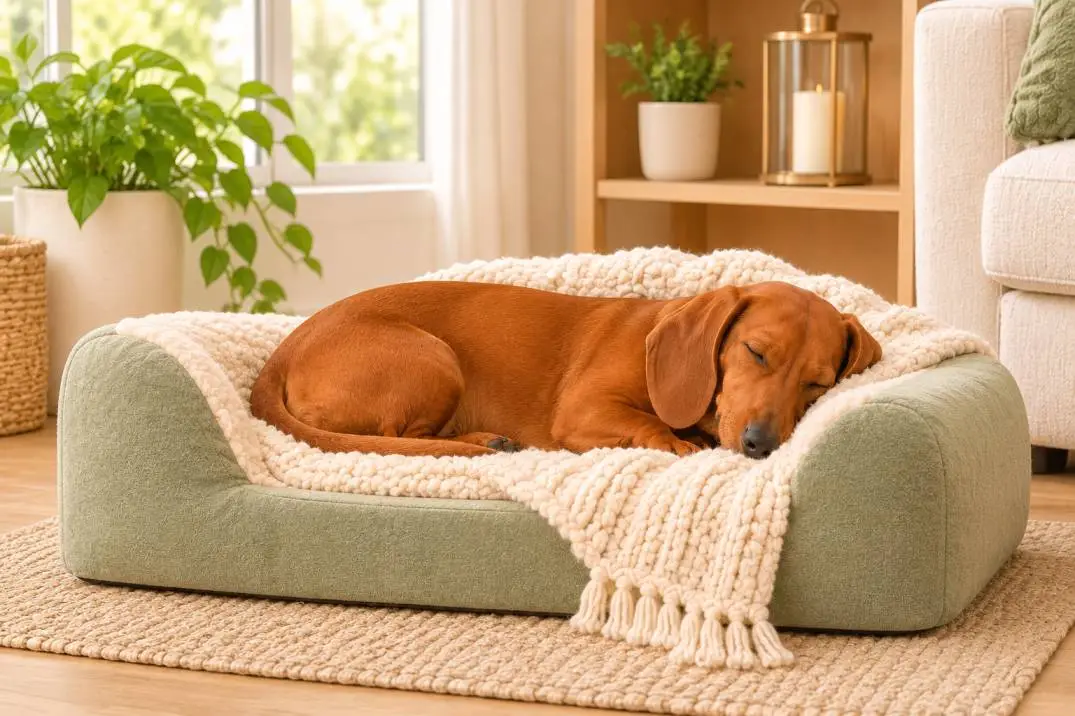
Dachshunds were bred to burrow after badgers (the name literally means “badger dog” in German, as Purina notes), so many of them love to curl up under a blanket in a snug nook. A good bed leans into that instinct while protecting a back that spends a large part of every day lying down.
Features worth paying for
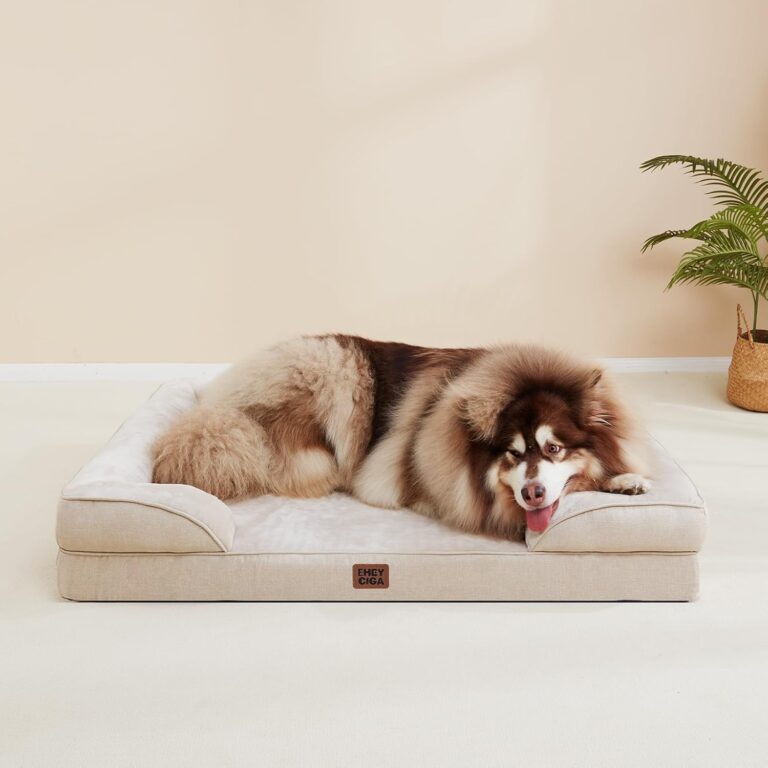
Supportive foam. A dog this long needs even support under the whole spine. High-density or memory foam keeps the back from sagging and cushions joints. Thin, flat, polyester-filled pillows tend to flatten quickly.
Low entry. Skip beds with tall walls your dog must hop over. A low front lip or an open side lets him step in.
Bolsters on three sides, or a cuddler design. A raised edge gives him something to rest a chin on and a feeling of being tucked in.
Non-slip base. Beds that skate across tile make dachshunds scramble to get in, which is exactly the awkward twisting we don’t want.
A washable cover. Long-haired dachshunds especially shed into everything. A zip-off cover saves your sanity.
The right size. Measure your dog from nose to base of the tail while he’s lying stretched out, then add a few inches. A bed he can fully stretch out on in his sleeping position beats a cozy one that forces his spine into a bend.
Put the bed on the floor, not on a raised platform, and keep one near wherever you spend your evenings so he isn’t tempted onto the sofa. One honest caveat: I couldn’t find any study that tests dachshund beds, so these are practical criteria, not research findings.
Beds worth a look
Pick the size by your dog’s stretched-out length, not by weight. These four came up again and again in dachshund bed reviews.
- Furhaven Orthopedic Sofa-Style Bed or Round Snuggery: egg-crate foam on a foam base. One review lists the Medium Snuggery at about 3 inches high with an attached blanket hood for burrowing, for dogs up to 30 pounds.
- PetFusion Ultimate Orthopedic Memory Foam Dog Bed: memory foam with a low front entry and a waterproof liner.
- Bedsure Memory Foam Bolster Dog Bed: a budget option with 6-inch bolsters, a low-profile entry, a waterproof protector and a washable cover.
- Best Friends by Sheri Calming Donut Bed: a favorite with dogs that curl and burrow. It isn’t an orthopedic bed and its sides are deep, so it’s better as a second bed than as the main support bed.
The supporting cast: small things that add up
A few extras that cost very little and quietly protect your dog:
- Baby gates to close off stairs when you can’t supervise.
- Non-slip runners or rugs over hardwood and tile, for better footing.
- A car ramp so he’s never jumping into or out of the back seat. For the ride itself, see the car travel section below.
- A kitchen scale and measuring cup to keep meals measured. More on weight just below.
- An early start. Science for Animal Welfare says disc degeneration can begin as early as four months, so it’s worth building ramp habits and careful handling in puppyhood. Re-check harness fit as he grows.
Check your dachshund’s weight before you shop
Vets use the nine-point body condition score from the World Small Animal Veterinary Association (WSAVA) Global Nutrition Committee. A 4 or 5 is ideal. At that score you can feel the ribs easily under a light covering, see a waist when you look down from above, and see the belly tuck up behind the ribs from the side. No waist and no tuck means he’s carrying extra. Go by touch rather than the scale alone, and ask your vet to score him and set a target weight.
Cornell advises keeping dogs trim and fit, and Purina notes dachshunds are at risk of back injuries, particularly when overweight. The research linking weight to IVDD itself is mixed (the RVC survey found no association; earlier studies did), but extra weight is hard on every joint, so this is a cheap step worth taking before you buy anything.
Car travel: pick a restraint that has been crash-tested
Veterinary bodies don’t crash-test restraints, so this is the one place I lean on a non-veterinary source: the Center for Pet Safety (CPS), an independent non-profit. In a 2013 study with Subaru, CPS reported that many harnesses marketed with safety claims performed poorly, and only one brand consistently kept the test dog on the seat. In a 2015 pilot of small-dog travel seats, CPS found that these seats don’t give full containment, and a plastic buckle connector broke in one test. It also says a collar or ordinary walking harness is not designed to take crash forces. CPS recommends full containment, meaning a crash-tested carrier or crate, for smaller dogs rather than booster-style seats.
- Look for the CPS Certified logo and check CPS’s current list, because certifications change.
- Be wary of any product that says “crash tested” without naming who tested it.
- Ask your vet whether a carrier or crate suits your dog’s back. I found no study of travel restraints on dachshunds specifically.
Car restraints worth a look
- Sleepypod Clickit Sport or Clickit Terrain Harness: the only harness line I found with Center for Pet Safety certification. Check the smallest size and its minimum weight against your dog before you buy. For a very small dog, CPS recommends full containment, and Sleepypod also makes certified carriers, so check the current CPS list.
- Ruffwear Load Up and Kurgo Tru-Fit Crash Tested Harness: both are described as manufacturer-tested, but the reviews I read did not list them as CPS-certified. Treat them as a step down from a certified product.
Warning signs: when to stop shopping and call the vet
Gear is prevention, not treatment. Call your vet the same day if your dachshund shows any of these. According to Science for Animal Welfare, early signs of disc pain include reluctance to climb steps or jump into the car, unprovoked yelping, a hunched stance with the head low, a tense neck or back, or trouble turning in tight circles. Cornell adds that a dog may avoid turning its head, stand over its food bowl without eating, or walk with a wobbly gait. Weak back legs, inability to walk or loss of bladder control are emergencies, because spinal cord damage is time-sensitive and treatment speed can change the outcome.
A reminder that not every back episode ends in surgery, but you can’t tell which will at home. Let a vet make that call.
If your dachshund has already hurt his back: what the specialists say
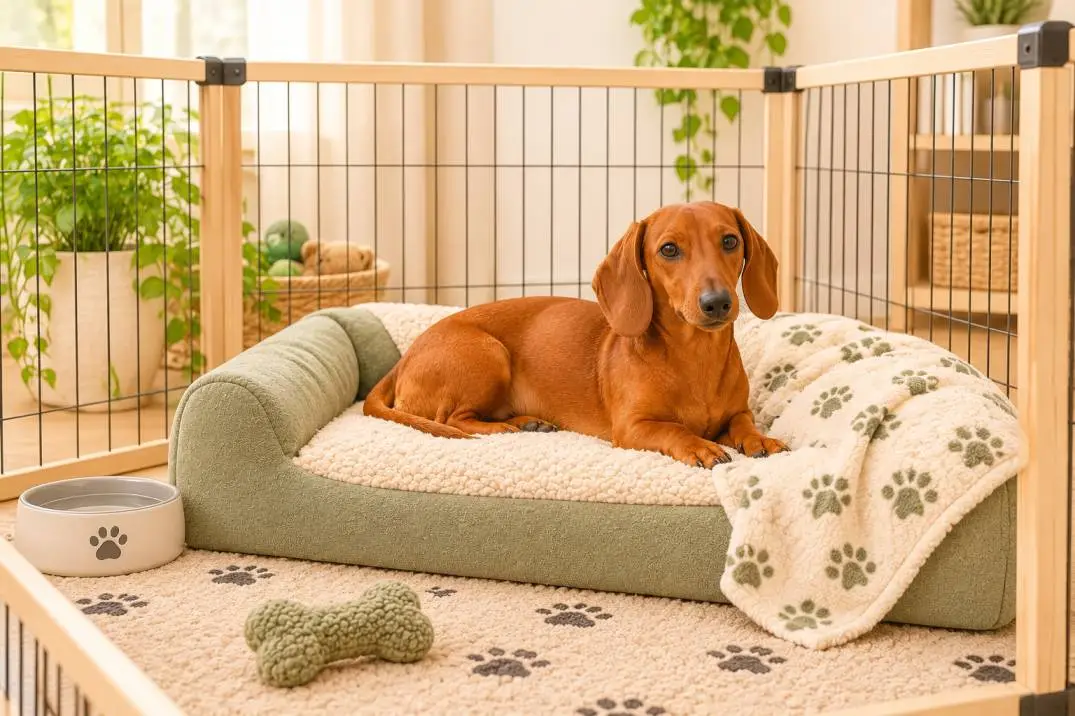
Everything above is about prevention. If your dog has been diagnosed, your vet’s plan comes first, and the shopping list changes. An eight-member panel of veterinary specialists wrote the ACVIM consensus statement (2022) on disc extrusion in the mid and lower back. Its recommendations are worth knowing so you buy the right things.
- Rest comes first. The panel recommends at least four weeks of restricted activity: a crate ideally, or a small room without furniture, with outdoor toileting on a leash, no jumping on or off furniture and no stairs. It rates the evidence as low, so this is largely expert consensus. The same four-week minimum applies after surgery.
- That changes what you need. During strict rest, a ramp up to the sofa is the wrong tool, because he shouldn’t be on furniture at all. A properly sized crate or pen, non-slip flooring and a harness for leashed toilet trips matter more. Ramps come back once your vet clears activity.
- Rehab is basic and vet-guided. The panel supports simple exercises such as passive range of motion, massage and assisted standing and walking, which it notes need no specialized equipment, with activity increasing after the restriction period.
- Ask before buying mobility gear. I couldn’t find a veterinary guideline on when a support sling or wheelchair is appropriate, so ask your vet or a canine rehabilitation therapist about timing and fit before you order one.
- Recurrence is real. The panel reports recurrence of 15 to 66 percent with medical management, and new disc extrusions after surgery in up to 19 percent of dogs, with higher rates in dachshunds (25 percent in one study). Prevention gear stays useful for life.
- A dog that can’t walk needs a vet urgently. The panel recommends surgical management for dogs that can’t walk.
Quick buying checklist
- Ramp: long and shallow, grippy, stable, side rails, right weight limit.
- Harness: padded, straps clear of the shoulder blades and armpits, sized by chest girth, two-finger fit, nothing tight across the back.
- Bed: supportive foam, low entry, non-slip base, washable, sized for stretching out.
- Extras: gates, floor traction, car ramp, a crash-tested car restraint, and a measuring cup for meals.
Frequently asked questions
Do all dachshunds need a ramp?
Not every dachshund will need one, but I’d add one wherever your dog jumps every day. The research on whether ramps prevent IVDD is thin, so treat it as a sensible precaution, not a guarantee. Cornell advises limiting jumping on and off beds and sofas, and a ramp also cuts the risk of a bad fall. Young dogs count too, since disc degeneration can begin in the first year. Your vet can tell you how strict to be.
Are stairs ever okay?
Often, yes, but the advice conflicts. The Danish study found moderate stair use associated with less disc calcification, and the RVC survey saw a similar but statistically weak trend, though neither proves cause and effect. Cornell still advises minimizing stairs. A sensible middle path is calm, steady use of low stairs and no charging down a full flight. When in doubt, carry him, supporting chest and hindquarters. If he’s had a back episode, follow your vet’s rules.
Harness or collar?
Harness for walking, collar for ID tags. No study shows a harness prevents IVDD, so think of it as neck comfort and control rather than back protection. If your dog pulls, it keeps the pressure off his throat.
What size bed does a miniature dachshund need versus a standard?
Measure your own dog, nose to tail base, plus a few inches. Miniatures top out around 11 pounds and standards run 16 to 32, so sizes differ, but individual dogs vary.
What if my dog already had a back episode?
Follow your vet’s plan and see the recovery section above. Cornell notes that mild cases are managed with restricted activity and pain medication, and that recovery from spinal surgery can take months, with crate rest first and then strictly controlled exercise. Dogs who have had one episode can have another, so ask your vet which restrictions to keep.
The bottom line
You can’t change your dachshund’s genes. But you can build a home where the long back is rarely asked to do something risky: a ramp where the sofa used to be a launchpad, a harness where the collar used to be, a bed that holds his spine level, and a trim waistline, which Cornell recommends. Be realistic about what that buys you: fewer falls and hard landings, not a guarantee.
None of it is glamorous, and none of it is a guarantee. But it’s reasonable, low-cost protection. Start with the ramp, add the harness, and let the bed upgrade come next. And if you’re reading this because something already seems off, put the shopping cart down and call your vet.
Have a dachshund of your own? Tell us which ramp or bed finally won your dog over. A real owner’s tip beats any spec sheet.
Sources and further reading
- Science for Animal Welfare (UFAW): Intervertebral Disc Disease in Dachshunds
- Cornell Richard P. Riney Canine Health Center: Intervertebral Disc Disease
- Cornell Richard P. Riney Canine Health Center: Chondrodystrophy and IVDD (CDDY/IVDD)
- Olby NJ, Moore SA, Brisson B, Fenn J, Flegel T, Kortz G, Lewis M, Tipold A. ACVIM consensus statement on diagnosis and management of acute canine thoracolumbar intervertebral disc extrusion. J Vet Intern Med, 2022;36(5):1570-1596
- Packer RMA, Seath IJ, O’Neill DG, De Decker S, Volk HA. DachsLife 2015: lifestyle associations with the risk of IVDD in Dachshunds. Canine Genetics and Epidemiology, 2016
- Jensen VF, Ersbøll AK. Mechanical factors affecting intervertebral disc calcification in the dachshund. J Vet Med A, 2000 (PubMed)
- The Influence of Harness Design on Forelimb Biomechanics in Pet Dogs (Reinvention journal; small study, 30 dogs)
- World Small Animal Veterinary Association (WSAVA) Global Nutrition Committee: Body Condition Score charts (wsava.org)
- Center for Pet Safety and Subaru: 2013 pet harness crash-test study and 2015 pet travel seat pilot study (independent non-profit, the only non-veterinary safety source)
- Purina: Dachshund breed information (manufacturer breed profile, used only for size, breed history and the overweight note)