First-Time Cat Owner’s Guide to Cat Obligate-Carnivore Nutrition
How to choose complete cat food, understand labels, and avoid common feeding myths.
Bringing home your first cat can make feeding time feel surprisingly complicated. One bag says “high protein,” another says “grain-free,” social media recommends raw meat, and homemade recipes promise to recreate a cat’s natural diet. With so many confident claims, how do you know what your cat actually needs?
The answer begins with one important biological fact: cats are obligate carnivores. However, that phrase is often misunderstood. It does not mean that every carbohydrate is toxic, that vegetables automatically make food unhealthy, or that feeding plain chicken creates a complete diet.
It means cats have unique nutritional requirements—including taurine, arachidonic acid, arginine, and preformed vitamins—that must be reliably supplied through a properly formulated diet. For most first-time cat owners, the safest solution is a food labeled ‘complete and balanced’ for the cat’s correct life stage. Homemade diets can also work, but they require exact formulation from a qualified veterinary nutrition specialist.
This beginner-friendly guide explains what “cat obligate-carnivore nutrition” really means, how to read cat-food labels, which common myths to avoid, and what to know before considering homemade cat food.
Quick answer: Choose a cat food made for your cat’s species and life stage, confirm that it carries an appropriate nutritional adequacy statement, feed measured portions, provide fresh water, and speak with your veterinarian before adding supplements or replacing commercial food with a homemade recipe.
Affiliate disclosure: This article contains affiliate links. We may earn a commission if you purchase through our links, at no additional cost to you. As an Amazon Associate, I earn from qualifying purchases. Some links may also lead to Raw Paws Pet Food.
What Does “Obligate Carnivore” Mean for Cats?

An obligate—or true—carnivore is an animal whose metabolism has adapted around nutrients found in animal tissues.
Cats evolved as hunters eating prey naturally rich in protein, moderate in fat, and relatively low in carbohydrates. Unlike dogs, cats have several nutrient requirements that cannot be reliably met by an unplanned plant-based diet. These include taurine, arginine, arachidonic acid, preformed vitamin A, and vitamin D.
This is why simply feeding a cat the same food as a dog is unsafe. Cats and dogs have different nutrient requirements, and food should always be formulated specifically for the intended species. AAFCO notes that cats require nutrients such as taurine and preformed vitamin A that distinguish their nutritional needs from those of dogs.
For a first-time cat owner, the practical takeaway is simple:
- Your cat needs a nutritionally complete feline diet.
- Protein quality and amino-acid balance matter.
- Animal-derived nutrients are essential.
- “Meat-based” does not automatically mean “complete.”
- Extra supplements are not automatically beneficial.
A bowl of chicken breast, turkey, tuna, or ground meat may contain useful protein, but muscle meat alone does not provide every vitamin, mineral, fatty acid, and amino acid a cat needs long-term.
The Essential Nutrients Every Cat Diet Must Provide

A balanced feline diet is much more than meat and calories. It must provide nutrients in the right amounts and ratios.
High-quality protein and amino acids
Cats need dietary protein to support muscles, organs, enzymes, hormones, skin, and coat. Kittens require particularly careful protein quality and amino-acid balance because they are still growing. Animal proteins generally provide a strong amino-acid profile, but the finished diet—not a single ingredient—must meet the cat’s complete requirements.
Chicken, turkey, duck, beef, eggs, and fish may all contribute nutrients to a feline diet. However, no single protein source should be treated as a complete nutritional formula by itself.
Taurine
Taurine is one of the most important nutrients in feline nutrition. Cats cannot make enough taurine to meet their needs, so it must be supplied through food.
Taurine deficiency has been associated with dilated cardiomyopathy and retinal degeneration. These conditions can lead to serious heart disease and loss of vision. Properly formulated commercial cat foods include sufficient taurine for their intended use, while homemade diets require precise calculation and supplementation.
Do not add a random taurine dose to an improvised recipe and assume the diet is complete. Taurine is only one part of a much larger nutritional equation.
Essential fatty acids
Dietary fats provide energy, help with the absorption of fat-soluble vitamins, and supply essential fatty acids.
Cats require linoleic acid and also arachidonic acid, which is found in animal fats and cannot be efficiently produced from vegetable oils. Marine sources such as oily fish, krill oil, and algae oil can provide EPA and DHA, while plant oils provide different fatty-acid profiles.
This means sunflower oil should not be described as creating a complete omega-3 and omega-6 balance on its own. Oil selection must be based on the entire recipe and the cat’s total fatty-acid intake.
Vitamins and minerals
Calcium, phosphorus, iron, zinc, copper, iodine, B vitamins, vitamins A, D, and E, and many other nutrients must be supplied in controlled proportions.
More is not always better. Cornell warns that unnecessary vitamin and mineral supplementation can be harmful when a cat already eats a complete and balanced diet. Supplements should be used only when professionally recommended.
Are Carbohydrates and Vegetables Bad for Cats?

This is where many online articles become misleading.
Cats do not have a specific dietary requirement for carbohydrates in the same way they require taurine or arachidonic acid. However, that does not mean every carbohydrate is poisonous or that properly formulated food containing cooked starch is automatically unhealthy.
Merck explains that healthy adult cats can metabolize diets containing a moderate amount of calories from carbohydrates and can digest cooked plant-derived nutrients. Cats remain obligate carnivores because of their unique nutrient requirements—not because their digestive systems are completely incapable of handling cooked carbohydrates.
The better question is not
“Does this food contain any carbohydrates?”
Ask instead:
- Is it complete and balanced for my cat’s life stage?
- Does it provide sufficient protein and essential nutrients?
- Is the calorie level appropriate?
- Does my cat maintain a healthy weight and body condition?
- Does my cat tolerate the food well?
- Does the manufacturer employ qualified nutrition experts and follow strong quality-control practices?
WSAVA cautions that the ingredient list alone does not reveal ingredient quality or the overall nutritional quality of a food. Scientific formulation, expertise, feeding research, and quality control are often more meaningful than marketing words such as “premium,” “natural,” or “grain-free.”
Carbohydrate restriction may be part of managing certain medical conditions, including feline diabetes, but an individual treatment diet should be selected with a veterinarian.
How to Choose Cat Food in the United States
Walking through a pet-food aisle can feel overwhelming, but first-time owners can simplify the decision by following a few reliable checks.
1. Confirm that it is made for cats
Never assume dog food, human food, or plain meat can serve as a complete everyday cat diet.
2. Match the food to the correct life stage
Look for a statement indicating suitability for:
- Growth or kittens
- Adult maintenance
- Gestation and lactation
- All life stages
Kittens need different nutrient levels and feeding rates than adult cats. A calorie-rich growth diet may contribute to weight gain if fed unnecessarily to a less-active adult.
3. Find the nutritional adequacy statement
The most important small print on the package is the nutritional adequacy statement.
Look for language showing that the food is complete and balanced for the intended species and life stage according to an AAFCO nutrient profile or feeding protocol. AAFCO explains that “complete” means the necessary nutrients are present, while “balanced” means they are supplied in appropriate ratios.
Products labelled for “intermittent or supplemental feeding only” should not replace a complete everyday diet unless your veterinarian specifically directs you to use them.
A Smarter Way to Shop for Wet Cat Food
Wet food can contribute moisture to your cat’s diet, but the front of the package does not tell the whole story. Before choosing a product, confirm that it:
- Is formulated specifically for cats
- Matches your cat’s life stage
- Includes a complete-and-balanced nutritional adequacy statement
- Provides clear calorie information
- Is not labeled only for intermittent or supplemental feeding
- Fits any recommendations from your veterinarian
Explore Complete-and-Balanced Wet Cat Food
4. Look beyond the front of the package
Attractive claims do not necessarily indicate superior nutrition.
WSAVA recommends considering whether the company employs qualified nutrition professionals, conducts appropriate research, maintains quality-control procedures, and can provide detailed nutritional information.
5. Choose a format that works for your cat
Dry, canned, and combination feeding can all be suitable when the diet is complete and balanced.
Canned food generally contains much more moisture and can contribute to water intake. Dry food is convenient and often less expensive, but portions should still be measured rather than endlessly refilled. Your veterinarian can help determine the most suitable option for your cat’s preferences, health, lifestyle, and body condition. Is Homemade Cat Food a Good Idea?
Homemade feeding can sound appealing because it offers control over ingredients. The major challenge is not cooking the meat—it is meeting dozens of interdependent nutrient requirements consistently.
UC Davis researchers evaluated 114 homemade cat-food recipes from books and online sources. Of the 94 detailed enough for nutritional analysis, none met all National Research Council recommended allowances for healthy adult cats. Many were deficient in several nutrients, and some included potentially toxic ingredients.
Tufts veterinary nutrition specialists similarly warn that most homemade diets need concentrated supplements and exact ingredient measurements. Substituting one meat, oil, supplement, or quantity for another can significantly alter calories and nutrient levels. What about eggshell powder, eggs, taurine, oils, and flaxseed?
These ingredients may appear in professionally formulated recipes, but their inclusion does not automatically make a recipe balanced.
- Eggshell powder can supply calcium, but the correct amount depends on the recipe’s phosphorus content and total formulation.
- Eggs provide protein and several micronutrients, but they do not supply everything a cat needs.
- Taurine is essential, but adding taurine alone cannot correct other deficiencies.
- Plant and marine oils supply different fatty acids and are not interchangeable.
- Flaxseed or fiber may be used for a specific formulation goal, but fiber is not universally required in the same amount for every cat.
- General multivitamins may provide too little of one nutrient and too much of another.
The safest approach is to obtain a precise recipe from a board-certified veterinary nutritionist and follow it without substitutions. Homemade diets are especially risky for kittens, pregnant or nursing cats, and cats with medical conditions.
Veterinary nutrition notice: Do not use an online recipe as your cat’s full-time diet unless it has been individually formulated or approved by a qualified veterinary nutrition professional.
You should not add a universal “balanced homemade cat-food recipe” with fixed ingredient amounts to the article. None of the authoritative sources we reviewed provides one, and the evidence shows why: UC Davis evaluated 114 published homemade cat-food recipes; among the 94 detailed enough to analyze, none supplied every essential nutrient at the recommended level. Some were missing multiple nutrients, while others contained potentially toxic ingredients.
Cornell recommends commercially prepared complete-and-balanced food for most cats unless a veterinarian recommends a home-formulated diet, in which case the recipe should be developed by a veterinarian certified in animal nutrition.
Practical Feeding Essentials for First-Time Cat Owners
The food itself matters most, but a simple feeding setup can make storage, serving, and cleanup easier.
| Food-storage container | |
|---|---|
| Feeding Mate | Reusable can lids |
Can You Make Complete and Balanced Homemade Cat Food?
Yes—but a nutritionally complete homemade cat diet is not simply a mixture of meat, eggs, calcium, oils, and supplements.
Cats require precise amounts and ratios of amino acids, fatty acids, vitamins, and minerals. The final formula must account for the nutrient content of every ingredient, the calories in the finished food, the cat’s life stage, body condition, health history, and individual energy needs.
That is why there is no single homemade recipe that is appropriate for every kitten, adult cat, senior cat, or cat with a medical condition.
A UC Davis analysis of 114 homemade cat food recipes found that none of the 94 recipes detailed enough for full nutritional analysis met all National Research Council recommended allowances for adult cats. Common deficiencies included choline, iron, zinc, thiamine, vitamin E, and manganese.
Cornell therefore recommends feeding nutritionally balanced commercial food unless a veterinarian specifically recommends a homemade diet developed by a qualified veterinary nutrition specialist.
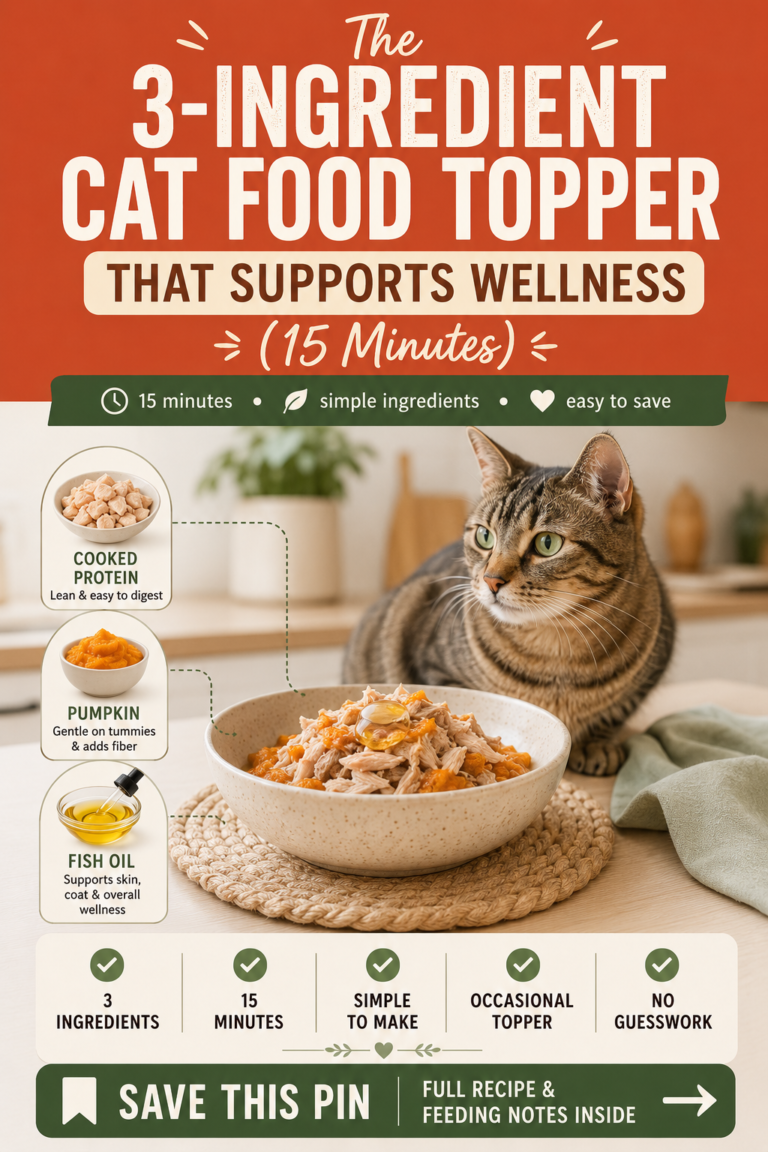
Looking for a safe way to add a little homemade variety without replacing your cat’s complete diet? Try our homemade chicken catloaf recipe and easy homemade cat food topper recipe. It is designed as an occasional topper to serve alongside complete and balanced cat food—not as a full meal replacement.
Considering Raw or Freeze-Dried Cat Food?
Raw and freeze-dried products do not all serve the same purpose. Some may be complete diets, while others are treats, toppers, or supplemental products.
Before using one as your cat’s main food, check whether the exact product:
- Is formulated specifically for cats
- Is complete and balanced
- Matches the appropriate life stage
- Includes clear calorie and feeding information
- Provides safe handling and storage directions
Explore Raw Paws Cat Food Options
Important: A product labeled as a treat, topper, or “for intermittent or supplemental feeding only” should not replace your cat’s complete daily diet.
Ingredients a Professionally Formulated Recipe May Include
Depending on the individual recipe, a veterinary nutritionist may use the following:
- A cooked animal-protein source, such as turkey, chicken, beef, or another suitable protein
- Specific organ meat in a carefully calculated amount
- A precise calcium source
- A source of essential fatty acids
- Taurine
- Carefully selected vitamins and trace minerals
- Water or another moisture source
- A recipe-specific veterinary supplement or nutrient premix
These ingredients are not interchangeable.
For example:
- Chicken cannot always be replaced gram-for-gram with turkey.
- Eggshell powder cannot be added by guesswork because the correct calcium amount depends partly on the phosphorus content of the entire recipe.
- Fish oil, krill oil, sunflower oil, and other oils supply different fatty acids.
- A human multivitamin is not an appropriate substitute for a feline recipe supplement.
- Adding taurine does not correct deficiencies in iron, iodine, vitamin D, thiamine, copper, zinc, or other nutrients.
Cornell also warns that unnecessary vitamin and mineral supplementation can be harmful, particularly when a cat already eats a complete and balanced diet.
How to Prepare a Veterinary-Formulated Homemade Diet
Once your veterinarian or veterinary nutrition specialist gives you a written recipe, follow these steps exactly.
1. Confirm That the Recipe Matches Your Cat
The written recipe should identify:
- Your cat’s life stage
- Current and ideal weight
- Health conditions
- Daily calorie target
- Exact ingredients
- Required supplement
- Batch yield
- Calories per gram
- Daily serving amount
- Storage instructions
A recipe created for a healthy adult cat should not automatically be used for a kitten, pregnant cat, senior cat, or cat with kidney disease, diabetes, urinary problems, food allergies, or another medical condition.
2. Buy the Exact Ingredients Listed
Use the exact:
- Meat cut
- Fat percentage
- Ingredient form
- Supplement brand
- Supplement amount
- Oil type
- Organ type
Do not substitute ingredients without asking the professional who formulated the recipe.
Changing lean ground turkey to fatty turkey, replacing liver with another organ, or switching supplement brands may change the nutrient and calorie profile of the finished food.
3. Weigh Everything in Grams
Do not measure important ingredients with
- Handfuls
- Household spoons
- An empty pet-food can
- Visual estimates
Even a small measuring error can become significant when the diet is fed every day.
4. Cook the Ingredients as Directed
Cook animal ingredients thoroughly unless the professionally written recipe gives different instructions.
Do not add:
- Salt
- Garlic
- Onion
- Leeks
- Sauces
- Seasoning blends
- Butter
- Broth containing onion or garlic
UC Davis found that some online recipes contained potentially toxic ingredients, including garlic, onion, and leeks.
Cornell does not recommend raw meat diets because of the possible presence of bacteria, parasites, and other pathogens that can affect cats and people.
5. Cool the Cooked Food
Allow the cooked ingredients to cool according to the recipe instructions before adding any supplement identified as heat-sensitive.
Do not automatically assume every supplement must be added after cooking. Follow the exact directions supplied with the professionally formulated recipe.
6. Add the Prescribed Supplement Exactly
Use the full amount specified for the entire batch.
Do not reduce the supplement because it appears large, and do not add extra taurine, calcium, vitamins, or oils “for additional health benefits.”
More is not always better. Excess amounts of some vitamins and minerals may also cause harm.
7. Mix the Entire Batch Thoroughly
The supplement must be distributed evenly throughout the food.
Poor mixing may result in one meal containing too much supplement and another containing too little.
8. Weigh the Finished Batch
Record:
- Total finished weight
- Number of portions
- Calories per gram, as supplied in the professional recipe
- Date prepared
This makes daily portioning more accurate.
9. Portion and Store According to the Written Plan
Divide the batch into daily or meal-sized portions.
Refrigerate the portions that will be used promptly and freeze the remaining portions according to the recipe’s food-safety instructions. Label each container with the preparation date.
Do not repeatedly thaw and refreeze food.
Helpful Tools for Following a Veterinary-Formulated Recipe
These tools can help you follow a professionally written recipe more accurately. They do not make an unverified recipe complete or balanced.
Precision Digital Kitchen Scale
A digital scale is essential when the recipe lists ingredients in grams. Look for gram measurements, a tare function, and an easy-to-clean platform. Explore Precision Kitchen Scales on Amazon
Instant-Read Food Thermometer
A thermometer helps confirm that cooked ingredients reach the preparation temperature specified in the recipe. See Instant-Read Food Thermometers
Food-Safe Portion Containers
Small containers make it easier to divide the finished batch into daily or meal-sized portions.
View Food-Safe Portion Containers
Freezer-Safe Meal-Prep Containers
Freezer-safe containers are useful when preparing several portions in advance. Label each container with the preparation date and portion amount.
View Freezer-Safe Meal Containers
Safety reminder: Use only the exact ingredients, supplement, quantities, and cooking method supplied by the veterinary professional who formulated the recipe.
How to Calculate the Daily Portion
The correct daily portion must be calculated from the calorie density of the finished recipe—not simply from the cat’s weight or the volume of a measuring cup.
Use this formula:
Daily food in grams = your cat’s prescribed daily calories ÷ calories per gram of the finished recipe
Need help converting your cat’s estimated calories into cans, pouches, cups, or grams? Try our [Free Personalized Cat Feeding Calculator] using your cat’s age, weight, neuter status, body-condition score, and food-label calories.
For example, if the veterinary recipe states that the finished food contains a specific number of calories per gram, use that number together with the daily calorie target prescribed for your cat.
Then divide the total daily amount into the recommended number of meals.
Do not copy a universal statement such as
“Every 10-pound cat should eat 140 grams per day.”
Two cats of the same weight may have different energy requirements because of differences in age, activity, body condition, neuter status, environment, and health. Cornell advises owners to work with their veterinarian to determine the cat’s ideal weight and adjust intake accordingly.
Suggested Feeding Schedule
Many adult cats can be offered two or more measured meals per day, but the exact schedule should suit the individual cat and the veterinary plan.
A written feeding plan may divide the daily amount into:
- Two meals
- Three smaller meals
- Several small measured meals
Always calculate the total daily amount first, and then divide it. Do not accidentally feed the full daily quantity at every meal.
Transitioning to the New Diet
Do not suddenly replace your cat’s current food unless your veterinarian instructs you to do so.
A gradual transition may involve increasing the new food while reducing the previous food over several days. However, the appropriate transition speed depends on the cat’s health, food tolerance, and reason for changing diets.
Contact your veterinarian if your cat:
- Stops eating
- Vomits repeatedly
- Develops persistent diarrhea
- Becomes unusually tired
- Loses weight
- Refuses the new diet
- Shows changes in urination or thirst
Cats that stop eating can develop serious health problems, so prolonged food refusal should never be treated as ordinary pickiness. Cornell recommends veterinary examination when a cat refuses food and loses weight.
What If You Do Not Yet Have a Veterinary Recipe?
Until you obtain a professionally formulated plan, continue feeding a commercial cat food labeled ‘complete and balanced’ for your cat’s correct life stage.
Plain, thoroughly cooked, unseasoned chicken or turkey may be used occasionally as a small treat or topper, but it is not a complete diet.
Cornell recommends that treats generally remain a small part of a cat’s total daily calories and states that homemade food should not replace a complete diet unless a veterinarian recommends an appropriate formulation.
Homemade Diet Safety Checklist
Before feeding homemade cat food as the main diet, confirm that:
- Your cat has received a veterinary examination.
- The recipe was created for your individual cat.
- It was formulated by a qualified veterinary nutrition professional.
- It states the calories per gram.
- It provides a precise daily portion.
- Every ingredient is measured in grams.
- The exact supplement is available.
- No ingredients have been substituted.
- The diet is cooked and stored safely.
- Your cat’s weight and body condition will be monitored.
- The recipe will be reassessed if your cat’s age, weight, or health changes.
Important: A collection of seemingly healthy ingredients does not prove that a recipe is complete and balanced. The nutritional balance depends on the exact ingredients, nutrient concentrations, quantities, cooking method, supplement, and daily calorie intake.
Veterinary nutrition notice: We do not publish a universal homemade cat-food formula because cats have complex, individualized nutrient requirements. The preparation and portioning guidance below explains how to follow a professionally formulated recipe; it is not itself a complete diet prescription.
How Much Should You Feed Your Cat?
There is no universal rule stating that every 10-pound cat should eat a fixed number of grams.
The right portion depends on:
- Calories per cup, can, or gram
- Ideal body weight
- Current body-condition score
- Age
- Activity level
- Neuter status
- Indoor or outdoor lifestyle
- Medical conditions
Try our [Personalized Cat Feeding Calculator]
Start with the feeding directions on a complete and balanced food, then monitor your cat’s weight and body condition. AAFCO notes that feeding directions are guidelines and may need adjustment when an animal gains or loses weight.
Cornell recommends working with your veterinarian to identify an ideal weight and modify intake accordingly. Obesity is one of the most common nutrition-related health problems in cats.
A kitchen scale can help you measure food consistently, but the correct gram amount depends on the food’s calorie density—not simply the cat’s weight.
Tools That Make Measured Feeding Easier
These products can help you serve a chosen amount consistently. They do not calculate how many calories your individual cat needs.
Automatic Portion-Control Cat Feeder
An automatic feeder may help maintain a regular schedule when you are away at mealtime. Program it using your cat’s established daily amount rather than relying on the machine’s default portion.
Slow-Feeder Cat Bowl
A cat-appropriate slow feeder may help some fast eaters take more time with meals. Choose a shallow, easy-to-clean design that does not make eating excessively difficult.
Measuring Scoop
A marked scoop is convenient, but it is less precise than weighing food because kibble density and scoop-filling methods vary. See Cat Food Measuring Scoop
Portion reminder: Calculate or confirm the full daily amount first, then divide that total between meals.
First-Time Cat Owner Feeding Checklist
Before choosing your cat’s daily food, confirm:
- It is formulated specifically for cats.
- It matches your cat’s life stage.
- It has an appropriate nutritional adequacy statement.
- It is not labelled only for intermittent or supplemental feeding.
- You know how many calories it provides.
- You measure portions instead of guessing.
- Fresh water is always available.
- Treats do not replace balanced meals. For a simple occasional option, see our [3-ingredient homemade cat food topper].
- Supplements are approved by your veterinarian.
- Any homemade diet was formulated by a veterinary nutrition specialist.
- You monitor weight, appetite, stool quality, coat, and energy level.
- You contact a veterinarian if your cat stops eating or loses weight unexpectedly.
Frequently Asked Questions
Can cats live on chicken and rice?
Chicken and rice is not a complete long-term feline diet. It lacks the full balance of taurine, calcium, essential fatty acids, vitamins, minerals, and other nutrients cats need. Use a temporary bland diet only when directed by a veterinarian.
Does “high protein” automatically mean better cat food?
No. The quantity, digestibility, amino-acid profile, calorie balance, and total formulation all matter. A food should first be complete and balanced for the correct life stage.
Is grain-free food necessary for cats?
Not automatically. Grain-free does not mean carbohydrate-free, and grains are not inherently harmful to most cats. Select food based on nutritional adequacy, your cat’s health, and professional guidance—not a single marketing claim.
Should I add taurine to commercial cat food?
Usually not. A complete and balanced commercial cat food should already provide appropriate taurine. Additional supplementation should be discussed with your veterinarian because unnecessary supplements can disrupt the diet’s balance.
The Bottom Line
Understanding that your cat is an obligate carnivore is important—but it should guide you toward balanced nutrition, not oversimplified rules.
Your cat needs reliable animal-associated nutrients, appropriate protein, essential fatty acids, vitamins, minerals, hydration, and the right number of calories. For most first-time owners, the simplest and safest choice is a reputable commercial food labeled ‘complete and balanced’ for the cat’s life stage.
If you prefer a homemade diet, do not rely on a general internet recipe, scoop food by volume, or label it. Work with your veterinarian and a board-certified veterinary nutritionist to develop a precise plan for your individual cat.
Your cat does not need the most fashionable diet. Your cat needs a complete, carefully formulated diet that supports healthy growth, body condition, and long-term well-being.
References and Further Reading
- Cornell Feline Health Center. (2026). Feeding Your Cat. Cornell University College of Veterinary Medicine.
https://www.vet.cornell.edu/departments-centers-and-institutes/cornell-feline-health-center/health-information/feline-health-topics/feeding-your-cat
Covers obligate-carnivore nutrition, complete and balanced diets, commercial food, supplements, hydration, homemade diets, and weight management. (Université Cornell – Médecine Vétérinaire) - Sanderson, S. L. (2024). Nutritional Requirements of Small Animals. Merck Veterinary Manual.
https://www.merckvetmanual.com/management-and-nutrition/nutrition-small-animals/nutritional-requirements-of-small-animals
Covers taurine, amino acids, fats, carbohydrates, vitamins, minerals, calorie requirements, and risks associated with unbalanced homemade diets. The article is written by a board-certified veterinary nutrition specialist and peer reviewed. (Merck Veterinary Manual) - Merck Veterinary Manual. (2024). Overview of Nutrition: Small Animals.
https://www.merckvetmanual.com/management-and-nutrition/nutrition-small-animals/overview-of-nutrition-small-animals
Provides an overview of complete and balanced nutrition, ingredient interpretation, commercial diets, nutritional assessment, and feeding practices. (Merck Veterinary Manual) - Association of American Feed Control Officials. (n.d.). Selecting the Right Pet Food.
https://www.aafco.org/consumers/understanding-pet-food/selecting-the-right-pet-food/
Explains nutritional adequacy statements, life-stage claims, feeding directions, and the meaning of “complete and balanced.” (AAFCO) - World Small Animal Veterinary Association. (n.d.). Global Nutrition Guidelines and Nutritional Toolkit.
https://wsava.org/global-guidelines/global-nutrition-guidelines/
Includes veterinary nutrition guidelines, body-condition tools, calorie guidance, pet-food evaluation resources, and advice for identifying reliable nutrition information. (WSAVA) - Quinton, A. (2019). Is Homemade Cat Food Nutritious? University of California, Davis.
https://www.ucdavis.edu/magazine/is-homemade-cat-food-nutritious
Summarizes research showing that analyzed online and published homemade cat-food recipes commonly failed to meet all recommended feline nutrient requirements. (ucdavis.edu) - Heinze, C. R. (2016). Should You Make Your Own Pet Food at Home? Petfoodology, Cummings School of Veterinary Medicine at Tufts University.
https://sites.tufts.edu/petfoodology/2016/07/14/should-you-make-your-own-pet-food-at-home/
Explains why homemade diets require professional formulation, exact measurements, appropriate supplementation, and strict adherence to the original recipe. (sites.tufts.edu) - National Research Council. (2006). Nutrient Requirements of Dogs and Cats. The National Academies Press.
https://www.nationalacademies.org/publications/10668
A detailed scientific reference covering nutrient and energy requirements for dogs, cats, puppies, and kittens. (nap.nationalacademies.org) - Veterinary Secrets. (n.d.). Veterinary Secrets website.
https://veterinarysecrets.com/
How this article was researched: This guide was prepared using veterinary and official nutrition resources from Cornell University College of Veterinary Medicine, the Merck Veterinary Manual, AAFCO, WSAVA, UC Davis, Tufts University, the National Academies, and Veterinary Secrets. It is intended for educational purposes and does not replace individualized advice from a veterinarian or board-certified veterinary nutritionist.