Puppy Collar Size Chart by Breed , Neck Size and Age
Puppy Collar Size Chart: How to Measure for the Right Fit

A brand-neutral sizing and fit guide for first-time puppy owners
Bringing home a puppy comes with many small decisions, and collar sizing is one of the easiest to get wrong. A collar that is too loose may slip over your puppy’s head. One that is too tight can rub, pinch, or become uncomfortable as your puppy grows.
The most reliable way to choose a puppy collar is simple: measure your puppy’s neck, compare that number with the exact adjustable range on the product label, and check the fit again after the collar is on. Breed, weight, and age can help you narrow down the options, but they should never replace an actual measurement.
| Quick answer
Measure around the part of your puppy’s neck where the collar will sit. Choose a lightweight collar whose adjustable range includes that measurement without placing your puppy at the very tightest or loosest setting. After fastening it, use the finger check and make sure the collar cannot slide over the head. |
Puppy collar size chart
There is no universal collar-size standard. One brand’s “small” may overlap another brand’s “extra small.” The chart below is a shopping reference, not a substitute for the manufacturer’s size chart.
| Measured puppy neck | Common adjustable ranges | Labels often used | What to prioritize | |
| 6-8 in (15-20 cm) | 6-8 in. or 6-10 in | XXS | Very lightweight webbing and small hardware | |
| 8-10 in (20-25 cm) | 8-12 in | XS | A narrow, light collar with room to adjust | |
| 10-12 in (25-30 cm) | 10-14 inches or 10-15 inches | XS or S | Comfortable edges and a secure buckle | |
| 12-16 in (30-41 cm) | 12-18 in or 14-20 in | S or M | Enough adjustment room without excess bulk | |
| 16-20 in (41-51 cm) | 15-21 in, 16-24 in, or 18-26 in | M or L | Proportionate width, sturdy D-ring, low weight | |
| 20-26 in (51-66 cm) | 18-26 in, 20-28 in, or 24-30 in | L or XL | Strong hardware that is still comfortable for a growing dog | |
| Important limitation
These ranges reflect common retail sizing patterns, not a universal puppy standard. Always follow the exact chart for the collar you are buying. |
||||
Why breed, age, and weight are only starting points
Puppies of the same breed and age can have different neck sizes. Coat thickness, sex, body shape, growth rate, and individual genetics all matter. Even major retail sizing guides use overlapping breed and weight examples, which is a useful reminder that a breed name cannot choose the collar for you.
Use this order of importance:
- Your puppy’s current neck measurement
- The manufacturer’s adjustable range
- A hands-on fit check after fastening
- Breed and weight as secondary clues
- Age only as a reminder that the collar may be outgrown quickly
Breed groups as a rough starting point
| General puppy group | Examples | What to expect |
| Toy and very small puppies | Chihuahua, Toy Poodle, Yorkshire Terrier, Miniature Dachshund | Often start in the smallest, lightest collar ranges |
| Small puppies | Cavalier King Charles Spaniel, Pug, Maltese, Miniature Schnauzer | May fall between extra-small and small depending on age and build |
| Medium puppies | Beagle, Cocker Spaniel, Border Collie, Australian Shepherd | Often need more adjustment room during rapid growth |
| Large puppies | Labrador Retriever, Golden Retriever, German Shepherd, Boxer | Can outgrow starter collars quickly; avoid buying a heavy adult collar too early |
| Giant-breed puppies | Great Dane, Mastiff, Newfoundland | Need frequent measuring, but the collar should still be proportionate to the puppy now |
These examples are not prescriptions. Measure the individual puppy before you order.
How to measure your puppy’s neck for a collar
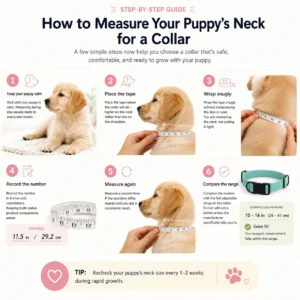
You need a soft measuring tape. A piece of non-stretch string and a ruler also work.
- Wait until your puppy is calm. Measuring during play usually produces an inaccurate number.
- Place the tape where the collar will sit. For a standard flat collar, this is usually higher on the neck rather than low on the shoulders.
- Wrap the tape snugly without compressing the skin or coat. You are measuring the neck, not pulling the tape tight.
- Record the number in inches and centimeters. Keeping both makes product comparisons easier.
- Measure a second time. If the two readings differ, repeat until you get a consistent result.
- Compare the number with the full adjustable range. Do not add arbitrary inches unless the manufacturer specifically tells you to.
| Measurement example
If your puppy’s neck measures 10.5 inches, a collar adjustable from 10 to 15 inches may be a better starting point than one adjustable from 8 to 11 inches. The first range leaves useful room for adjustment; the second places the puppy close to the loosest limit. |
How to read a collar label
A label may say: 5/8 in wide x 9-15 in adjustable
- 5/8 inch is the collar’s width.
- 9-15 inches is the neck-size range the collar is designed to fit.
- Do not choose from the word “small” alone. Compare the numbers because size names vary by brand.
How tight should a puppy collar be?
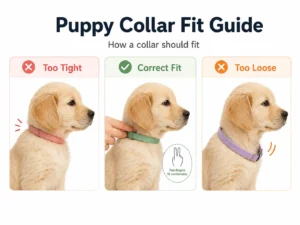
The collar should be snug enough that it does not slide over your puppy’s head, but loose enough that it does not pinch or restrict movement.
The familiar two-finger rule is a useful starting check for many dogs. For a tiny puppy, one finger may be more proportionate. For a large puppy, two fingers may be appropriate. The important point is not the exact number of fingers; it is whether the collar is secure, comfortable, and unable to slip over the head.
- Slide your fingers beneath it.
- Gently move the collar around the neck.
- Check that it does not press into the throat.
- Guide it forward toward the ears without forcing it; it should not pass over the head.
- Recheck while your puppy is standing, sitting, and lying down.
Signs the collar is too tight
- You cannot slide a finger or fingers beneath it comfortably.
- It leaves a deep indentation in the skin or coat.
- The skin looks red, rubbed, swollen, or sore.
- Your puppy repeatedly scratches at the neck after the introduction period.
- Your puppy coughs, gags, or has noisy breathing when pressure is placed on the leash.
- The buckle is difficult to close without pulling the ends together.
| When to contact a veterinarian
Remove the collar and contact your veterinarian if you notice persistent redness, swelling, hair loss, sores, coughing, breathing changes, or pain. A collar guide cannot diagnose the cause. |
Signs the collar is too loose
- It can slide over your puppy’s head.
- Your puppy can place a lower jaw, paw, or leg beneath it.
- It rotates freely, and the buckle repeatedly moves under the throat.
- The ID tag or hardware catches frequently on nearby objects.
- Your puppy backs out of it when startled or when the leash becomes tight.
Dogs with narrow heads or dogs that regularly slip out of flat collars may need a different, professionally fitted setup. Ask a qualified trainer or veterinarian whether a properly fitted martingale collar or secure harness is more suitable.
As a general fit check, the American Kennel Club recommends placing two fingers beneath the collar: if they do not fit, the collar may be too tight; if several fingers fit easily, it may be too loose.
What if your puppy is between two sizes?
Do not automatically choose the biggest collar so your puppy can “grow into it.” An oversized collar may be too heavy, rotate excessively, or slip over the head.
- Choose a collar whose range safely includes the current neck measurement.
- Prefer a range that leaves adjustment in both directions.
- Compare the collar’s weight and hardware size with your puppy’s body.
- Check the retailer’s return or exchange policy before removing tags.
- Measure again when the collar approaches either end of its adjustment range.
How wide should a puppy collar be?
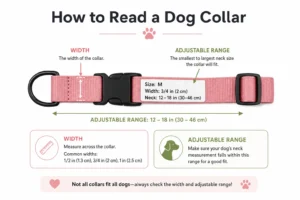
Collar width should feel proportionate to the puppy. A tiny puppy usually benefits from narrow, lightweight webbing and small hardware. A larger puppy may need a wider collar and stronger D-ring, but stronger should not mean unnecessarily heavy.
- Smooth or softly finished edges
- A buckle that closes securely
- An adjustment slider that does not creep loose
- A D-ring that sits flat and feels solid
- Stitching without loose threads
- Hardware that does not press into the neck
How often should you check your puppy’s collar?
Puppies can change size quickly. Check the fit frequently, especially during visible growth spurts.
- When your puppy first wakes up or settles calmly
- After grooming or bathing
- Whenever the collar looks tighter or looser
- After a noticeable weight or coat change
- Before relying on the collar for a walk
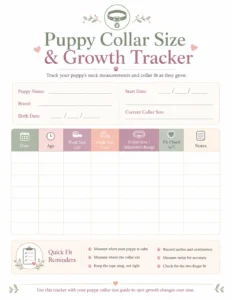
Write the measurement down instead of relying on memory. When the collar is near its maximum setting, damaged, frayed, stiff, or no longer comfortable, replace it.
Puppy collar growth tracker
How to help a puppy get used to a collar
A new collar can feel strange. Some puppies scratch at it, freeze, or try to bite it at first. Introduce it gradually in a calm space.
- Let your puppy sniff the collar.
- Touch it gently to the neck and reward calm behavior.
- Fasten it for a short, supervised session.
- Use treats, play, or a meal to create a positive association.
- Remove it before your puppy becomes frustrated.
- Increase wearing time gradually while checking the skin and fit.
Do not pull your puppy around by the collar to make them accept it. If scratching continues, inspect the fit, seams, moisture, skin, and coat. Persistent irritation deserves veterinary attention.
Should a puppy wear a collar in a crate or overnight?
Collars, tags, and hardware can catch on crate bars, furniture, or another dog’s mouth during play. Veterinary guidance recommends supervising dogs when they wear collars and harnesses because accidental catching can cause injury.
Many owners remove standard collars before crating or unsupervised rough play. The safest routine depends on your crate, household, escape risk, and puppy. Ask your veterinarian or a qualified trainer for advice tailored to your setup. Never leave a leash attached inside a crate.
Collar or harness for puppy walks?
A collar is useful for visible identification and everyday handling. A well-fitted harness can be a better leash-attachment point for puppies that pull hard, cough under leash pressure, have noisy breathing, or have neck sensitivity.
A harness does not replace a collar with current identification. Many families use both: a lightweight collar for ID and a properly fitted harness for walking.
Do not forget identification
A correctly fitted collar should carry current visible identification where appropriate. Include a phone number you answer and keep the information updated.
A collar and tag can be lost, so visible identification should be paired with a registered microchip. Update the microchip registry whenever your phone number or address changes.
A registered microchip provides permanent identification, but the American Veterinary Medical Association explains that it does not replace a collar with current identification tags.
AVMA’s microchipping and pet-identification guidance
Puppy collar buying checklist
☐ I measured my puppy’s actual neck.
☐ The product’s adjustable range includes that measurement.
☐ The collar will not start at its absolute tightest or loosest setting.
☐ The collar width and hardware look proportionate to my puppy.
☐ The buckle and D-ring are securely attached.
☐ The edges and seams look smooth.
☐ The collar has space for current identification.
☐ I understand the return and exchange policy.
☐ I will check the fit frequently as my puppy grows.
Frequently asked questions
What size collar does an 8-week-old puppy need?
There is no reliable universal size for an 8-week-old puppy. A Chihuahua puppy and a Great Dane puppy of the same age can need very different ranges. Ask the breeder or rescue for the current neck measurement when possible, then measure again when the puppy arrives.
Can I choose a puppy collar by weight?
Weight can help narrow the options, but it is less reliable than the neck measurement. Dogs of the same weight may have different neck shapes and coat thicknesses. Measure first and use weight second.
Should I buy a larger collar for my puppy to grow into?
Buy enough adjustment room for growth, but do not choose a collar that is currently loose, bulky, or heavy. The collar must fit safely today.
How tight should a puppy collar be?
It should be secure enough that it cannot slip over the head and comfortable enough for you to slide a finger or fingers underneath without forcing them. Recheck the fit in different positions.
How often should I measure my puppy’s neck?
Measure frequently during fast growth and any time the collar looks different. Recording measurements makes changes easier to notice.
What collar width is best for a small puppy?
Choose a narrow, lightweight collar with small hardware that does not overwhelm the puppy’s neck. Use the manufacturer’s neck range, product weight, and width information rather than relying on the size name.
Why is my puppy scratching at the new collar?
The collar may simply feel unfamiliar, but scratching can also be linked to poor fit, rough seams, trapped moisture, parasites, or skin irritation. Remove the collar and check the skin. Contact your veterinarian if scratching is persistent or accompanied by redness, sores, swelling, hair loss, or discomfort.
When should I replace a puppy collar?
Replace it when the neck measurement is near the end of the adjustable range, the buckle no longer closes securely, the webbing or stitching is damaged, the D-ring is bent, or the collar causes rubbing or discomfort.
The bottom line
A breed chart can help you start shopping, but your puppy’s current neck measurement should make the final decision. Measure carefully, compare the number with the exact product range, check the fit after fastening, and keep measuring as your puppy grows.
Once you know the right fit, compare our best dog collars for everyday use for identification, comfort, visibility, and value. New puppy parents can also use our first-time puppy essentials checklist to prepare the rest of the home.